

Starting an Aesthetics Business from Home UK: The 2026 Comprehensive Guide
- The Pond Parlor
- 2 minutes ago
- 11 min read
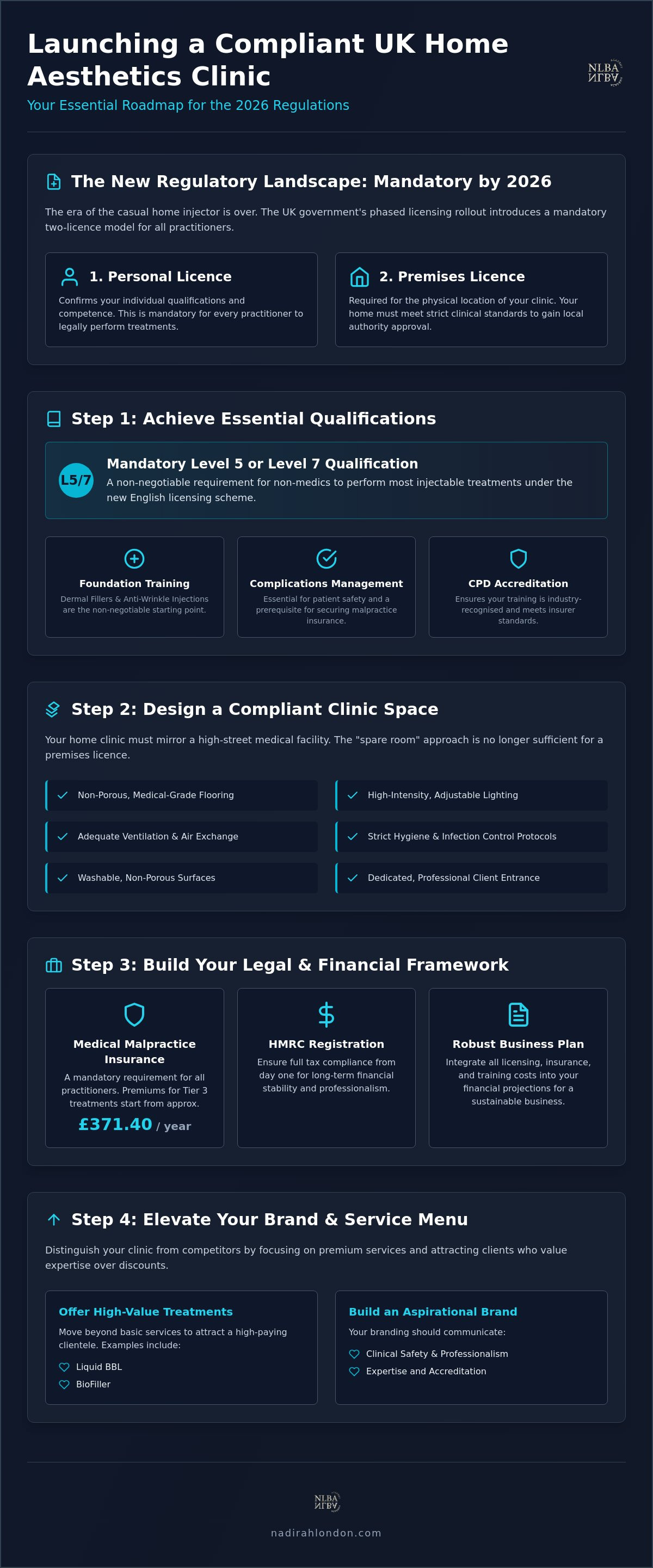
By the end of 2026, the era of the casual home injector is officially over. The UK government's phased licensing rollout means your home clinic must now mirror the clinical rigour and sophistication of a high-end medical spa. It's a significant shift. You're likely navigating the confusion of the new two-licence model while trying to ensure your home insurance remains valid under the latest 2026 standards. You want the freedom of working from home without sacrificing professional prestige or clinical safety.
Building a successful aesthetics business plan UK requires more than just technical skill; it demands a strategy that balances medical safety with luxury branding. This comprehensive guide delivers a complete roadmap to launching a compliant, professional, and high-profit clinic from your residence. You'll discover the exact steps to secure your personal and premises licences, the essential Level 5 and Level 7 qualifications for non-medics, and the secrets to attracting a steady stream of high-paying clients who value expertise over discounts. We'll break down the transition from aspiring practitioner to accredited clinic owner in this new era of UK regulation.
Table of Contents
Essential Qualifications and Accredited Aesthetics Training
Success within an aesthetics business plan UK starts with rigorous regulatory alignment. By mid-2026, the UK’s phased licensing rollout has redefined the barrier to entry. Non-medics now require a Level 5 or Level 7 qualification to perform most injectable treatments legally. This shift ensures every practitioner operates with clinical precision. Gaining a broad Aesthetic Medicine Overview is the first step in understanding the anatomical and physiological complexities of the skin and underlying structures.
To better understand the foundations of a successful clinic, watch this helpful video:
Accreditation separates professionals from hobbyists. CPD-accredited courses, such as those offered by Nadirah London Beauty Clinic & Academy, provide industry-recognised certification that insurers demand. Non-accredited workshops might offer lower costs; however, they often fail to meet the standards required for Medical Malpractice insurance. Foundation levels in Dermal Fillers and Anti-Wrinkle Injections are non-negotiable. They provide the anatomical knowledge required to avoid vascular occlusions and other critical errors. Nadirah London Beauty Clinic & Academy serves as an IPHM-approved executive member, offering worldwide accreditation that validates your expertise to a sophisticated clientele.
Choosing the Right Training Pathway
Effective training requires a hybrid approach. Online modules are excellent for theoretical anatomy; however, in-person clinical practice remains essential for mastering needle depth and product placement. Beginners should focus on high-demand services that offer immediate ROI. These include Dermal Fillers for volume restoration and Anti-Wrinkle Injections for natural, rejuvenated results. Nadirah London Beauty Clinic & Academy focuses on intensive hands-on experience with live models, ensuring you transition from student to practitioner with complete clinical confidence.
The Importance of Complications Management Training
Safety is your most valuable asset. Complications management training is the only way to secure professional insurance, with premiums for Tier 3 treatments starting from approximately £371.40 per year. You must be prepared to handle adverse reactions immediately. Nadirah London Beauty Clinic & Academy integrates clinical safety into every module, teaching you how to use hyaluronidase and manage emergency protocols. This expertise builds the trust necessary to attract high-paying clients who prioritise safety over price. Your aesthetics business plan UK must account for these ongoing training costs to maintain your premises licence under the 2026 regulations.
Designing a Compliant Home Clinic Space
Transitioning from a training environment to a home-based practice requires a shift from domestic comfort to clinical excellence. Under the 2026 regulations, a "spare room" approach no longer suffices. Your clinic must mirror the standards of a high-street medical facility to secure a premises licence. The UK Government Licensing Scheme mandates that any location performing non-surgical cosmetic procedures meets stringent hygiene and safety criteria. Integrating these physical requirements into your aesthetics business plan UK is the only way to ensure your application passes local authority inspections.
The physical environment must prioritise infection control. Carpets and porous surfaces are strictly prohibited; you'll need medical-grade vinyl or tiled flooring that can withstand industrial cleaning agents. Lighting must be high-intensity and adjustable to ensure precision during delicate procedures like tear trough fillers or anti-wrinkle injections. Ventilation is equally critical, requiring a system that ensures consistent air exchange to maintain a sterile atmosphere. While your clinic is residential, the client journey shouldn't feel domestic. A separate side entrance or a dedicated, professional hallway transition prevents clients from feeling like they're entering a private home, instantly elevating your brand's perceived value.
Clinical Hygiene and Infection Control
Hygiene is the foundation of clinical trust. Your treatment room requires a dedicated handwashing station with elbow-operated taps and liquid soap dispensers. You cannot use a domestic bathroom for clinical hand hygiene. Invest in an electric, height-adjustable medical couch and non-porous work surfaces. Every procedure must be performed within a sterile field. You'll also need a formal contract with a registered clinical waste provider. Sharps bins and yellow clinical waste bags must be stored securely and collected regularly, as local councils will request proof of these contracts during your Special Treatments licence inspection.
Privacy and Client Experience
Confidentiality is a legal requirement under GDPR and a cornerstone of luxury service. Soundproofing your clinic space ensures that private consultations remain private, even in a residential setting. Use ambient design elements like soft, neutral palettes and high-end scents to create a "London Luxury" feel that justifies premium pricing. The psychological impact of a professional setup cannot be overstated; it transforms a simple treatment into a sophisticated wellness experience. To ensure your skills match your high-end environment, consider refining your technique through accredited aesthetics training courses that focus on both clinical safety and luxury results. A professional setup significantly increases client retention, turning one-off bookings into long-term treatment plans.
Legal Requirements: Insurance, HMRC, and 2026 Licensing
Legal compliance is the structural backbone of a high-end home clinic. The 2026 regulatory landscape is defined by the UK Government Aesthetics Licensing Framework; a phased rollout that mandates a two-licence model. Your aesthetics business plan UK must account for both a personal practitioner licence and a separate premises licence for your home clinic. Operating without these is no longer an option. It's a legal necessity that ensures your practice meets national hygiene and safety standards. Professionalism starts with total transparency and rigorous adherence to these evolving mandates.
Insurance is your primary safeguard against clinical and operational risks. Standard home insurance policies don't cover aesthetic procedures; you require specialist medical malpractice and public liability cover. Public liability protects against accidental injuries on your property, while medical malpractice covers clinical errors during treatments. For Tier 3 treatments, including dermal fillers and anti-wrinkle injections, annual premiums typically start from £371.40 for £1,000,000 of cover. Additionally, GDPR compliance is mandatory. You must secure client data through encrypted digital records and professional consultation forms to protect patient confidentiality and your business reputation.
Navigating Local Authority Licensing
Licensing is managed at the borough level. Each local authority has specific criteria for practitioner and premises approval. To avoid licence refusal, ensure your home clinic meets the clinical standards detailed in previous sections. Common pitfalls include inadequate handwashing facilities or lack of accredited Level 5/7 qualifications.
Practitioner Licence: Validates your qualifications and clinical competency.
Premises Licence: Confirms your home space meets hygiene and safety protocols.
Council Inspections: Expect rigorous checks on waste management and sterile fields.
Financial Setup and Tax Obligations
Your financial structure impacts your long-term profitability. Most practitioners register with HMRC as a Limited Company to separate personal assets from business liabilities. For the 2026/2027 tax year, the VAT registration threshold is £90,000. If your turnover exceeds this, you must register and charge VAT on your services. Maintain clinical precision in your bookkeeping by using dedicated business banking and professional accounting software. Tracking every clinical expense; from consumables to advanced training at Nadirah London Beauty Clinic & Academy; is essential for accurate corporation tax reporting. Small profits under £50,000 are currently taxed at 19%, while higher earnings are subject to a tapered rate up to 25%.
Building an Aspirational Brand Identity and Client Base
A home clinic only succeeds if its branding mirrors the clinical precision of Harley Street. Your aesthetics business plan UK must prioritise a visual identity that screams sophistication. Clients aren't just paying for 1ml of filler; they're investing in an aspirational transformation. High-end branding bridges the gap between a residential postcode and a premium clinical experience. It projects an image of expertise that justifies your price point and builds immediate trust with a discerning audience.
Visual proof is your strongest currency. Instagram and TikTok are non-negotiable for showcasing your portfolio. Use professional lighting and high-resolution photography for every Before and After. This consistency builds trust and demonstrates technical mastery. To manage this demand, implement a professional booking system. Requiring deposits through an automated platform reduces no-shows and establishes your time as a valuable, high-demand commodity. This level of efficiency signals to clients that your home-based clinic operates with the same rigour as a flagship metropolitan academy.
Digital Marketing for Home Clinics
Local visibility is essential. Optimise your Google Business Profile to rank for "lip fillers near me" or "anti-wrinkle injections" in your specific borough. Effective local SEO is a cornerstone of any aesthetics business plan UK, helping you rank as a legitimate home-based practitioner against high-street competitors. Targeted social media ads allow you to reach a specific demographic; typically individuals aged 25 to 55 with high disposable income. Don't rely solely on algorithms. Build an email list to provide skin health education and exclusive loyalty offers. This direct line to your audience ensures long-term business stability regardless of social platform volatility.
Client Consultation and Retention
The consultation is where you transition from a service provider to a clinical expert. Sell outcomes, not product volume. Instead of selling "1ml of filler", discuss "mid-face rejuvenation" or "jawline definition". Create a bespoke "Skin Journey" for every client. This multi-month treatment plan encourages repeat bookings for Advanced Facials, IV Vitamin Drips, or PRP/PRF. Referral schemes for boutique businesses work best when they offer exclusive benefits to both the referrer and the new client, fostering a community of brand advocates. This strategy ensures a steady stream of high-paying clients who value your clinical precision.
Ready to master the techniques that drive these high-value results? Explore accredited training at Nadirah London Academy to elevate your clinical skills and brand authority.
Scaling Your Business with Nadirah London Beauty Clinic & Academy
Longevity in the aesthetics sector is predicated on continuous professional development. Once your home clinic is established and compliant, your aesthetics business plan UK must evolve to prevent revenue plateaus. The UK aesthetics market is currently growing at a rate of 8-10% per year, and capturing this growth requires moving beyond basic toxin and filler treatments. Scaling is about increasing the lifetime value of every client through advanced, specialized procedures that few home-based practitioners can offer with true proficiency. This strategic expansion is what eventually funds the transition from a residential space to a high-street flagship premises.
Nadirah London Beauty Clinic & Academy facilitates this transition by offering pathways into high-margin regenerative medicine and advanced body contouring. As your clinical confidence grows, incorporating sophisticated treatments allows you to target the rapidly expanding £4.8 billion male aesthetics market and the "prejuvenation" demographic. These are clients seeking long-term skin health rather than one-off corrections. By positioning your business as a center for advanced aesthetic craft, you move away from price-driven competition and toward a model based on exclusive expertise and clinical precision.
Advanced Aesthetic Mastery
Diversifying your service menu is the most effective way to stabilize cash flow. Advanced procedures often require fewer consumables relative to their high price point, significantly improving your profit margins.
Liquid BBL: A high-demand, non-surgical body contouring procedure that targets a premium client base.
BioFiller and PRP/PRF: Utilizing autologous blood concentrates to offer natural, regenerative results that appeal to the "clean beauty" demographic.
Advanced Facials and Skin Specialist Courses: Ensuring your clinic remains a destination for skin health between injectable appointments.
IV Vitamin Drips: Providing wellness-focused hydration that complements traditional aesthetic enhancements.
Mentorship and Support
The journey from a home-based room to a multi-room clinic is complex. Nadirah London Beauty Clinic & Academy provides more than just certification; we offer a clinical community and ongoing mentorship. Solo practitioners often struggle with the "what next" of business growth. Accessing insights from established experts helps you navigate the logistical hurdles of hiring staff or securing commercial leases. This mentorship ensures that as you scale, your standards of clinical safety and luxury branding remain uncompromised. Your aesthetics business plan UK should be a living document, updated regularly with the new skills and certifications you acquire through our academy.
Start your journey with Nadirah London Beauty Clinic & Academy today and redefine your professional ceiling.
Mastering the Future of UK Aesthetics
Launching a home-based clinic in 2026 requires a decisive shift from casual practitioner to clinical expert. Success depends on navigating the mandatory two-licence model and maintaining a domestic space that meets rigorous hygiene standards. Your aesthetics business plan UK must prioritize these regulatory foundations alongside a commitment to advanced clinical mastery. By integrating sophisticated branding with accredited expertise, you transform a residential service into a premier destination for physical transformation. Precision in your initial setup ensures long-term viability in a competitive market.
Professionalism is built on continuous education. As a trusted London beauty clinic and academy, Nadirah London specializes in high-value techniques like Russian Lips and advanced injectables. Our CPD accredited training ensures you remain compliant while delivering the high-impact results your clients desire. Don't let regulatory changes hinder your ambition; use them as a catalyst for excellence and clinical precision.
The transition from a home-based start-up to a high-profit enterprise is within your reach. With the right accreditation and a focus on clinical precision, your clinic will thrive in this new era of regulated beauty. Explore Accredited Aesthetics Courses at Nadirah London Academy and secure your place at the forefront of the industry.
Frequently Asked Questions
Do I need a medical degree to start an aesthetics business from home in the UK?
You don't need a medical degree to launch your practice, but you must hold the correct accredited qualifications. Under the 2026 licensing scheme, non-medics require a Level 5 or Level 7 qualification to perform most injectable treatments legally. These standards ensure that every practitioner, regardless of their medical background, operates with clinical precision and a deep understanding of facial anatomy.
What is the most important insurance for a home-based aesthetic practitioner?
Medical Malpractice insurance is the most critical protection for your clinical practice. It covers you against claims of professional negligence or treatment errors. You also need Public Liability insurance to protect against accidental injury to clients while they're on your property. Your aesthetics business plan UK should prioritize these as essential operational costs to ensure your premises licence remains valid.
Can my local council stop me from running an aesthetics clinic from my house?
Yes, your local authority can halt your operations if your home clinic doesn't meet the required hygiene and safety standards. You must obtain a premises licence, which involves a rigorous inspection of your treatment room. Councils also check that your business doesn't cause a nuisance to neighbors or violate residential planning permissions, often requiring a change of use application for your dedicated clinic space.
How much does it cost to set up a basic aesthetics room at home?
The cost of your setup depends on the level of clinical sophistication and luxury you aim to project. You'll need to invest in medical-grade furniture, high-intensity lighting, and non-porous flooring that meets infection control standards. While equipment costs vary, prioritizing high-quality clinical tools over domestic decor is essential for passing your initial council inspection and securing your practitioner licence.
What qualifications do I need to perform dermal fillers in the UK in 2026?
To perform dermal fillers, you must hold a practitioner licence, which requires a minimum of a Level 5 or Level 7 qualification for non-medics. This ensures you've completed accredited training in both the technical application of fillers and the management of potential complications. Continuous professional development is also mandatory to keep your skills current with the latest industry-standard techniques and safety protocols.
How do I get a prescriber if I am a non-medic starting an aesthetics business?
You must partner with a GMC or NMC registered prescriber to obtain prescription-only medicines like botulinum toxin. The law requires your prescriber to conduct a face-to-face consultation with every client before issuing a prescription. Many practitioners find prescribers through professional networking groups or specialized aesthetic pharmacies that offer oversight services for qualified non-medical injectors.
Is it better to register as a sole trader or a limited company for aesthetics?
Registering as a Limited Company is often the preferred choice for aesthetic practitioners because it limits your personal financial liability. This structure also offers greater tax efficiency once your business grows beyond initial profit thresholds. While being a sole trader is simpler to set up, the professional image and protection of a Limited Company align better with a high-end aesthetics business plan UK.
How do I ensure my home clinic meets clinical hygiene standards?
You must install a dedicated handwashing station with elbow-operated taps and ensure all surfaces are non-porous and easy to disinfect. Maintaining a sterile field during every procedure is non-negotiable. Additionally, you're legally required to have a formal contract with a clinical waste provider for the safe disposal of sharps and contaminated materials, as domestic waste collections don't cover clinical byproducts.


Comments