

How to Become an Aesthetic Practitioner in the UK: The 2026 Professional Roadmap

By the end of 2026, the "Wild West" era of UK aesthetics is officially over. The UK aesthetics market is projected to exceed £3.6 billion this year, bringing a new era of mandatory licensing and clinical accountability. Learning how to become an aesthetic practitioner UK standards demand means moving beyond basic workshops and into regulated, accredited pathways. The distinction between medic and non-medic is now secondary to holding a qualification that meets the new national licensing framework.
You've likely felt the uncertainty surrounding the new Red, Amber, and Green risk tiers or heard conflicting reports about who can legally perform injectables. It's a complex transition for anyone entering the field. This roadmap promises to clarify the 2026 regulatory landscape, detailing the exact qualifications and clinical steps required to launch a high-end career. We'll preview the new licensing laws, explore the necessity of professional indemnity insurance, and provide a clear checklist for finding a reputable training academy in London.
Key Takeaways
Navigate the mandatory 2026 UK licensing scheme and the specific tiered risk categories for non-surgical cosmetic procedures.
Master exactly how to become an aesthetic practitioner UK standards require by selecting the regulated qualification route tailored to your professional background.
Develop clinical precision through advanced training in facial anatomy and injection techniques for Dermal Fillers and Anti-Wrinkle Injections.
Secure your practice with specialist aesthetic insurance and a clinical environment that meets 2026 hygiene and CQC requirements.
Accelerate your career by enrolling in elite Aesthetic Training Courses within an active, high-end London clinic.
Table of Contents
Understanding the UK Aesthetics Industry and 2026 Licensing Regulations
Determining Your Entry Path: Qualification Routes for Medics and Non-Medics
Mastering the Clinical Essentials: Anatomy, Technique, and Complications
Transitioning from Student to Practitioner: Insurance, Premises, and Prescribing
Building an Elite Aesthetic Brand: The Nadirah London Academy Approach
Understanding the UK Aesthetics Industry and 2026 Licensing Regulations
An aesthetic practitioner is a specialist trained in non-surgical cosmetic interventions. In 2026, this role is defined by clinical excellence and strict regulatory compliance. The field of Aesthetic medicine has moved from a voluntary code of conduct to a mandatory legal framework. Understanding how to become an aesthetic practitioner UK professionals respect starts with the 2026 Licensing Scheme. This scheme ensures that every practitioner, regardless of their background, meets a national standard for safety and skill.
To better understand this professional journey, watch this helpful video:
The Joint Council for Cosmetic Practitioners (JCCP) remains the primary authority for setting education and practice standards. Professional accountability is now the leading driver for commercial success. Clients in 2026 prioritize practitioners who can demonstrate their inclusion on the national register and their adherence to the new licensing laws. Trust isn't just earned; it's verified through accreditation.
The Legal Framework: What has changed in 2026?
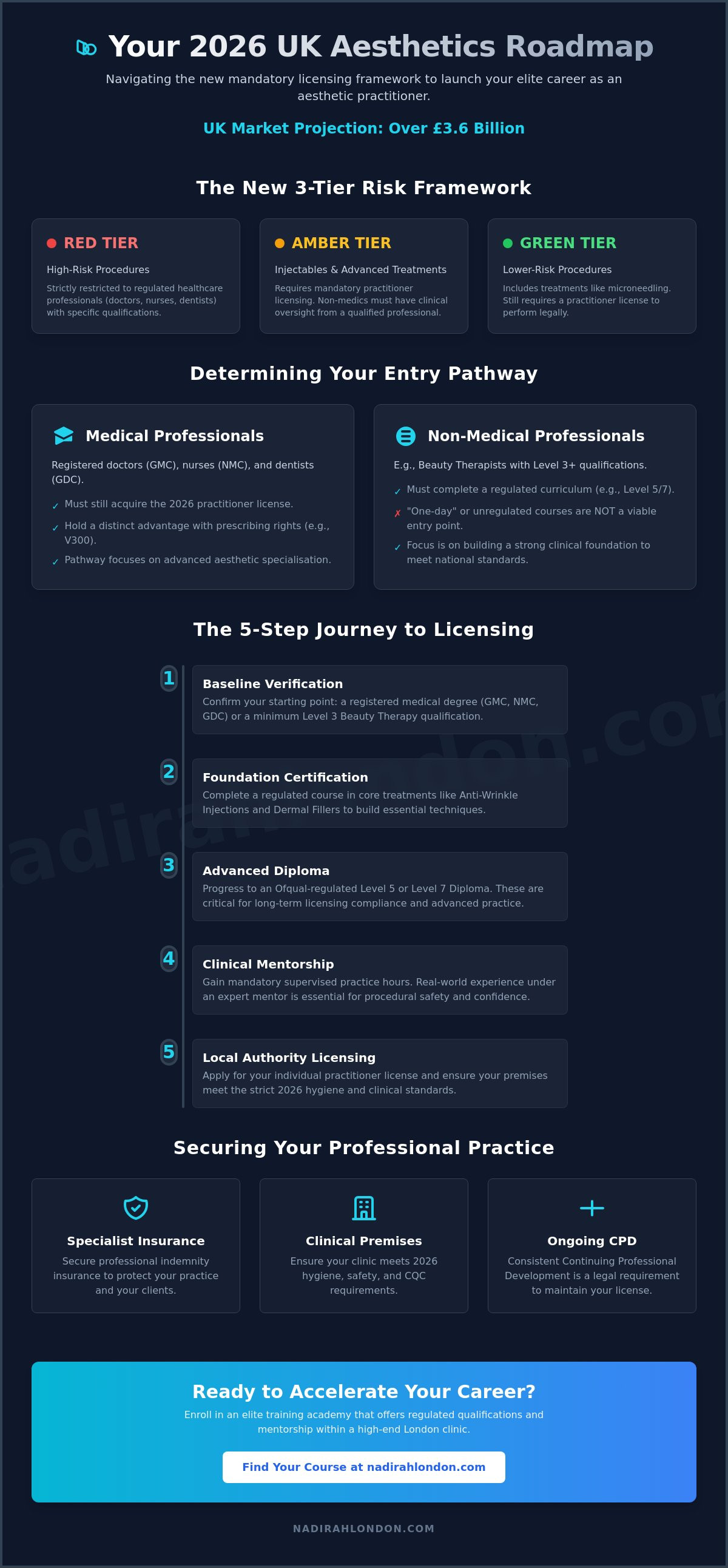
The 2026 framework uses a three-tier risk system. Red-tier procedures are high-risk and restricted to regulated healthcare professionals. Amber-tier treatments require practitioner licensing and, for non-medics, clinical oversight. Green-tier procedures are lower risk but still mandate a practitioner license. Local authorities now manage these licenses, requiring specific premises standards for hygiene and clinical waste disposal. Consistent CPD isn't optional. It's a legal requirement to maintain your license and ensure patient safety through the latest clinical techniques.
Medical vs. Non-Medical Practitioners
Registered doctors, nurses, and dentists operate within their professional scope but must still hold the 2026 practitioner license. For beauty therapists with a Level 3 qualification or higher, the pathway involves completing a regulated curriculum that aligns with national standards. Unregulated "one-day" training courses aren't a viable entry point. Success in the 2026 market depends on accredited, clinical training. Finding the right how to become an aesthetic practitioner UK pathway means choosing an academy that offers regulated qualifications rather than just attendance certificates. Precision and skill are the only ways to thrive in this sophisticated environment.
Determining Your Entry Path: Qualification Routes for Medics and Non-Medics
Your journey into aesthetic medicine depends entirely on your existing clinical or beauty background. The 2026 roadmap prioritizes structured progression over speed. Success requires a commitment to long-term clinical education. To understand how to become an aesthetic practitioner UK standards respect, follow this five-step professional sequence:
Step 1: Baseline Verification. Confirm your starting point. This is either a registered medical degree (NMC, GMC, GDC) or a Level 3 Beauty Therapy qualification.
Step 2: Foundation Certification. Complete a regulated course covering Anti-Wrinkle Injections and Dermal Fillers. This establishes your core injection techniques.
Step 3: Advanced Diploma. Progress to an Ofqual-regulated Level 5 or Level 7 Diploma. These qualifications are essential for long-term licensing compliance.
Step 4: Clinical Mentorship. Accrue supervised practice hours. Real-world experience under an expert mentor is mandatory for procedural safety.
Step 5: Local Authority Licensing. Apply for your individual practitioner license and ensure your premises meet the 2026 hygiene standards.
The Healthcare Professional Pathway
Registered nurses, doctors, and dentists hold a distinct advantage through prescribing rights. Holding an Independent Prescriber (V300) qualification allows you to manage the full patient journey, from initial consultation to complication management. For these professionals, the Level 7 Diploma in Clinical Aesthetic Injectable Treatments is the gold standard. It validates your clinical expertise in a cosmetic context. Fast-track options exist for experienced medics, but the focus remains on evidence-based practice and anatomical precision.
The Beauty Professional (Non-Medic) Pathway
Non-healthcare professionals now have a clear, regulated route into the industry. If you hold a Level 3 Beauty Therapy certificate, your first step is an "Access to Aesthetics" bridge course. This provides the necessary foundation in pathophysiology and clinical protocols. It's vital to choose Ofqual-regulated qualifications to ensure your future license is secure. According to the British Beauty Council, these standards protect both the practitioner and the public. Non-medics must also establish a formal partnership with a prescriber for botulinum toxin treatments, ensuring every procedure remains within the 2026 legal framework.
Mastering these steps is the only way to build a sustainable practice. If you are ready to begin your professional journey, explore the Aesthetic Training Courses available at our London academy to secure your place in this elite industry.
Mastering the Clinical Essentials: Anatomy, Technique, and Complications
Clinical mastery is the divide between a technician and an expert. While previous sections outlined the legal roadmap for 2026, the actual craft of administering injectables requires deep anatomical fluency. Mastering how to become an aesthetic practitioner UK regulators and high-end clients trust means prioritizing safety over speed. Every injection is a clinical decision involving skin histology, fat pads, and complex vascular networks. Theoretical knowledge is the baseline; precision is the standard.
Advanced Facial Anatomy and Physiology
Precision begins with mapping the face. You must identify "danger zones" where major arteries reside. Avoiding vascular occlusions is the primary goal of any advanced training. Understanding filler rheology is equally critical. You must select the correct G-prime for specific zones, such as high lifting capacity for jawlines versus soft integration for lips. This level of detail ensures results that are both safe and harmoniously transformative.
Technique choice defines the outcome. Needles offer unparalleled precision for fine lines and specific bolus placements. Cannulas provide a safer profile for volumization, significantly reducing trauma and bruising in the mid-face. Your skill in managing both tools determines your clinical versatility. The goal is always a sophisticated, natural-looking result that respects the patient's unique facial structure.
Complications Management and Patient Safety
Complications management is the most important skill you will ever learn. It is the hallmark of a true professional. The UK aesthetics industry regulations emphasize that safety protocols are no longer optional. Practitioners must be proficient in emergency reversal using Hyaluronidase for filler dissolution. You must also manage side effects ranging from simple bruising to delayed-onset nodules with clinical confidence.
Emergency Reversal: Mastery of Hyaluronidase protocols for immediate filler removal.
Side Effect Management: Clinical pathways for treating hematomas and inflammatory responses.
Patient Selection: Identifying psychological indicators and managing aesthetic expectations.
Safety Branding: Leveraging your clinical protocols to build an elite, trust-based reputation.
Ethics and the "psychology of beauty" are central to your practice. Rejecting a client is often more professional than performing a procedure that compromises their natural harmony or mental well-being. Identifying body dysmorphic indicators is as vital as needle placement. A "safety-first" reputation is your most valuable asset for attracting high-value, loyal clients in a competitive market.
Transitioning from Student to Practitioner: Insurance, Premises, and Prescribing
Clinical excellence is only half the battle. Transitioning into a professional role requires a robust operational framework. You must establish a clinical environment that satisfies both local authority inspectors and high-end clientele. Understanding the logistical backbone of how to become an aesthetic practitioner UK standards require involves securing your legal and physical infrastructure before treating your first private patient. This phase focuses on risk mitigation and professional legitimacy.
Insurance and Risk Management
Specialist aesthetic insurance is non-negotiable. You need a dual-layered approach. Public liability covers accidents within your premises. Professional indemnity protects you against claims of clinical negligence or malpractice. In the 2026 market, basic indemnity policies can start from approximately £6 to £8 per month. However, comprehensive coverage for higher-risk treatments like Dermal Fillers often requires premiums between £370 and £575 per year for £1 million in cover.
Risk management extends to your digital infrastructure. You must utilize encrypted patient management software for consent forms and clinical photography. These records are your primary defense in the event of a dispute. Handling negative feedback with clinical detachment and professionalism is a core business skill. Always follow your insurer's protocol when a complication or complaint arises.
The Logistics of a Prescribing Partnership
If you aren't a prescribing medic, you must establish a formal partnership with a qualified prescriber. Botulinum toxin is a Prescription Only Medicine (POM). The law requires a face-to-face consultation between the prescriber and the patient before any prescription is issued. Remote prescribing for cosmetic injectables is a violation of 2026 regulatory standards.
Sourcing is equally critical. You must only procure medical-grade products from reputable UK pharmacies. Using "black market" or imported fillers without UKCA marks invalidates your insurance and risks your practitioner license. Building a relationship with a mentor through Aesthetic Training Courses London can help you navigate these supplier networks safely. This ensures every product you inject meets the highest safety profile for your clients.
Your clinical environment must mirror your professional aspirations. Local authorities now manage licensing for green and amber-tier procedures, focusing on hygiene, sharps disposal, and sterilization protocols. A clean, sophisticated clinic isn't just a regulatory requirement; it's a core part of your brand identity. If you're ready to transition into a high-end clinical space, explore our professional aesthetic services to see how an elite London clinic operates.
Building an Elite Aesthetic Brand: The Nadirah London Academy Approach
Technical mastery is the entry requirement. Brand identity is the differentiator. In London's competitive market, clients don't just buy a procedure; they buy an aesthetic. Understanding how to become an aesthetic practitioner UK patients trust involves curating a reputation for sophisticated, high-impact results. Technical skill must be paired with an aspirational brand identity to attract a high-end demographic. Your clinic shouldn't just offer services; it should offer a transformation.
Mastering trending treatments is essential for staying relevant in 2026. High-demand procedures include:
Russian Lips: Precision vertical injection techniques for defined, flat-profile lift.
Liquid BBL: Advanced non-surgical body contouring using high-volume dermal fillers.
BioFiller: Utilizing autologous plasma for natural, regenerative volume enhancement.
PRP/PRF: Platelet-rich therapies for cellular-level skin rejuvenation.
IV Vitamin Drips: Premium wellness infusions to complement aesthetic interventions.
Lifelong learning is the hallmark of the elite practitioner. Your foundation course is merely the beginning of a professional journey. The 2026 landscape rewards those who constantly refine their technique and adapt to new clinical data. Success is a continuous pursuit of precision.
From Basic Injector to Aesthetic Artist
Moving beyond basic injections requires a deep understanding of facial harmony. Advanced facial contouring for jawlines and cheeks demands an artistic eye and clinical precision. The "Nadirah London" style focuses on achieving natural yet transformative results, avoiding the "over-filled" look in favor of structural balance. Use social media platforms like Instagram and TikTok to showcase this clinical excellence. High-quality, before-and-after imagery serves as a digital portfolio of your technical craft and aesthetic vision.
Why Choose Nadirah London Academy for Your Training?
Training at an active, high-end clinic like Nadirah London provides an experience that theory-only courses cannot replicate. You gain access to real-world clinical environments and expert mentorship from practitioners currently leading the industry. Our Aesthetic Training Courses are accredited and designed for both online and in-person learning, ensuring flexibility without compromising on depth.
Post-course support is a core pillar of our academy. We help you navigate the 2026 licensing landscape, from premises requirements to individual practitioner registration. You don't just leave with a certificate; you leave with a professional roadmap. Explore our accredited aesthetic courses and start your journey today. Join an elite tier of professionals dedicated to the highest standards of aesthetic medicine.
Secure Your Future in Elite Aesthetics
The 2026 regulatory shift marks the transition from a fragmented industry to a structured, clinical profession. Success in this £3.6 billion market requires more than just technical ability. It demands a commitment to national licensing standards and a sophisticated brand identity that resonates with high-end clients. Mastering how to become an aesthetic practitioner UK regulators and patients respect is a journey of continuous clinical refinement and strategic positioning.
You've explored the tiered licensing system, the necessity of anatomical precision, and the logistics of a compliant clinical environment. Now, it's time to translate that knowledge into a thriving practice. Choosing an academy that mirrors your professional aspirations is the most critical decision you'll make. The right environment provides the bridge between basic certification and elite artistry.
Launch your aesthetics career with Nadirah London Academy. Our programs are accredited by leading UK bodies and delivered within our high-end London clinic. You'll receive expert mentorship from active aesthetic practitioners who understand the nuances of the 2026 landscape. Your transformation into an elite practitioner starts here. Your future in aesthetic medicine is waiting.
Frequently Asked Questions
Do I need a medical degree to become an aesthetic practitioner in the UK in 2026?
No, a medical degree isn't the only entry point in 2026. While healthcare professionals have a distinct pathway, non-medics with a Level 3 Beauty Therapy qualification can enter via accredited bridge routes. Every professional must hold a regulated qualification that aligns with the new national licensing standards to practice legally in England. Clinical excellence and accredited certification are the primary requirements for the modern practitioner.
How much can an aesthetic practitioner earn in London?
Earnings for aesthetic practitioners in London vary based on clinic location, reputation, and the complexity of treatments offered. The UK aesthetics market is valued at approximately £3.2 billion, with high-end London clinics commanding premium rates for specialized procedures. Success is driven by building a loyal client base and mastering advanced techniques like Liquid BBL or BioFiller within a luxury clinical setting.
How long does it take to qualify as an aesthetic injector?
The timeline to qualify depends on your chosen training depth and existing background. A foundation course in Anti-Wrinkle Injections and Dermal Fillers can be completed in days. However, mastering how to become an aesthetic practitioner UK standards demand requires extensive clinical practice. A full Level 7 Diploma typically takes 12 to 18 months to complete alongside supervised mentorship and clinical observation.
Can a beauty therapist do Botox and fillers in the UK?
Yes, beauty therapists can perform these treatments provided they meet the 2026 licensing requirements. This involves holding a Level 3 qualification, completing a regulated bridge to aesthetics, and achieving an accredited Level 5 or 7 Diploma. Therapists must also partner with a qualified prescriber for all treatments involving Prescription Only Medicines (POMs) like botulinum toxin to ensure legal and clinical compliance.
What is the JCCP and should I join their register?
The Joint Council for Cosmetic Practitioners (JCCP) is the leading voluntary register for practitioners in the UK. While registration isn't currently a legal requirement, it's highly recommended for 2026 licensing. Joining the register demonstrates your commitment to clinical safety and professional accountability. It's a key voice marker for building trust with sophisticated clients who prioritize verified expertise and safety over price.
What happens if I practice aesthetics without a license in 2026?
Practicing without a practitioner and premises license in 2026 is a criminal offense under the new local authority schemes. Enforcement is managed by local councils in England. Penalties include heavy fines or the permanent closure of your clinic. The new licensing scheme ensures that only qualified professionals operating in hygienic, regulated environments can offer non-surgical cosmetic procedures to the public.
Do I need to be a prescriber to offer dermal fillers?
You don't need to be a prescriber to offer dermal fillers because they're currently classified as medical devices rather than Prescription Only Medicines. However, you must be a prescriber or work with one to offer Anti-Wrinkle Injections. The 2026 regulations prioritize patient safety, meaning a face-to-face consultation with a prescriber is mandatory for all POM treatments before the injection takes place.
What insurance do I need for an aesthetics business?
Your aesthetics business requires both professional indemnity and public liability insurance. Professional indemnity covers clinical negligence, while public liability protects against accidents on your premises. In 2026, some providers offer basic policies starting from around £6 to £8 per month. However, comprehensive coverage for advanced injectable therapies typically requires higher annual premiums to cover the full scope of clinical risks.


Comments