

How to Become an Aesthetic Practitioner in the UK: The 2026 Career Guide
- The Pond Parlor

- 5 days ago
- 11 min read
The era of unregulated "fast-track" aesthetics is officially over. As of July 2026, the UK's new licensing scheme demands more than just a basic certificate. It requires clinical precision. Mandatory local authority registration. Accredited expertise. You're likely feeling the pressure of these shifting laws. It's frustrating to face a landscape where "cowboy" academies still operate alongside legitimate Ofqual-regulated institutions. You want a career that offers both high-end luxury and absolute legal security.
This guide clarifies exactly which aesthetic practitioner qualifications UK you need to practice legally and safely. We'll provide a definitive roadmap for medical and beauty professionals to navigate the 2026 regulations. You'll learn the specific requirements for Level 5 advanced skin treatments and Level 7 injectables. We cover the necessity of professional indemnity insurance and the steps to launching a high-income clinic with total confidence. From mastering dermal fillers to understanding V300 prescribing protocols, this is your blueprint for professional transformation.
Table of Contents
What is an Aesthetic Practitioner? Defining the Role in 2026
The UK aesthetic sector is now a formal clinical environment. In 2026, an aesthetic practitioner is a professional who operates at the intersection of medical safety and high-end luxury. The days of unregulated "fast-track" certificates have ended. The 2022 Health and Care Act has fully matured into a mandatory licensing scheme. This requires every practitioner to hold specific, accredited aesthetic practitioner qualifications UK insurers and local councils now mandate. This transition from "beauty therapist" to "clinical aesthetician" represents a permanent shift toward professional accountability.
To better understand the professional standards required for modern injectors, watch this helpful video:
This evolution aligns the UK with international standards of Aesthetic Medicine Overview. Practitioners are no longer limited to surface-level facials. They manage a complex portfolio of clinical interventions designed for facial and body transformation. Mastery of these procedures requires a deep understanding of dermal layers and metabolic processes.
Anti-wrinkle injections using purified neurotoxins.
Dermal fillers for structural facial contouring.
Advanced BioFiller and PRP/PRF regenerative therapies.
Specialized skin protocols including IV Vitamin Drips.
Medical vs. Non-Medical Practitioners
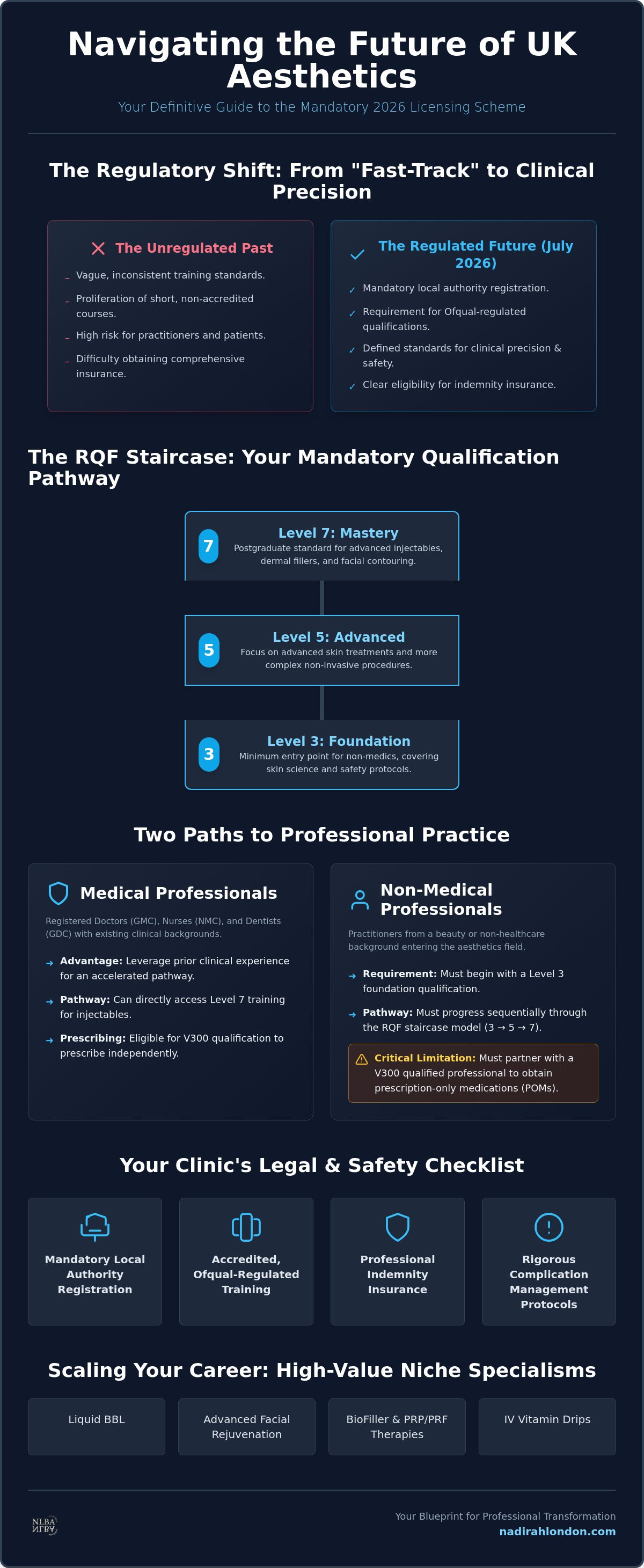
The 2026 market distinguishes between healthcare professionals and non-medics through specific licensing tiers. Registered doctors, nurses, and dentists (GMC, NMC, GDC) utilize their existing clinical backgrounds to transition into Level 7 aesthetics. For those from a beauty background, a Level 3 foundation is the minimum entry point to progress toward regulated aesthetics training. Prescribing remains a critical hurdle; non-prescribers must work alongside a V300 qualified professional to legally obtain prescription-only medications. This oversight ensures every patient receives a clinical consultation before treatment.
The Scope of Modern Aesthetic Practice
Modern practice focuses on clinical outcomes and risk mitigation. It's about more than aesthetic results. It's about safety. Practitioners must demonstrate mastery in several core areas to maintain their license. This includes deep anatomical knowledge of facial vasculature and nerve pathways. It also requires rigorous complication management training for immediate protocols like reversing vascular occlusions. Technical precision is paramount, especially when performing advanced procedures like Russian Lips or Liquid BBL. An aesthetic practitioner is a specialized professional who harmonizes clinical safety with artistic precision; many top-tier professionals enhance this creative eye through artistic workshops, such as those offered by arttherapy.ae, to deliver transformative, non-surgical facial and body enhancements.
The Entry Requirements: Qualifications You Need to Start
Entry requirements for the aesthetics industry are no longer flexible suggestions. They are now rigid legal benchmarks. Securing the correct aesthetic practitioner qualifications UK regulations mandate is a multi-stage process governed by the Regulated Qualifications Framework (RQF). The 2026 landscape operates on a "staircase" model. You cannot jump straight into advanced injectables without a documented foundation in skin science and clinical safety. This structured approach ensures every practitioner possesses the technical competency to handle high-risk procedures.
The JCCP Standards serve as the primary authority for practitioner registration and educational oversight. By following these guidelines, you align your career with the 2026 licensing scheme. This body bridges the gap between government regulation and clinical practice, ensuring that training providers meet rigorous OFQUAL requirements. If you're looking to begin this journey, enrolling in accredited aesthetic training is the most direct path to a compliant and insurable business.
The Medical Professional Pathway
Registered healthcare professionals, including those with GMC, NMC, or GDC registration, have a distinct advantage. Your prior clinical experience provides a foundation in patient assessment and infection control. However, the transition from the hospital ward to the aesthetic clinic chair requires specialized training. The Level 7 Diploma in Clinical Injectables is the gold standard for medical injectors. It moves beyond basic technique to focus on deep facial anatomy, rheology of dermal fillers, and emergency complication management. This postgraduate level of study is often required by premium insurers to cover high-value treatments.
The Beauty Professional Pathway
For non-medical professionals, the pathway is defined by the RQF levels. Level 3 Beauty Therapy is the absolute minimum entry point. From there, practitioners must progress through Level 4 and Level 5 bridge courses. Level 5 is specifically required for advanced treatments like chemical peels and microneedling. Beware of "fast-track" academies offering weekend certifications for fillers. These unregulated courses are a significant risk to your future license. In 2026, insurers and local councils strictly verify OFQUAL-regulated certifications. Without these, you cannot legally register your clinic or obtain professional indemnity insurance. Consistency in training is the only way to ensure long-term career stability in this competitive market.
Choosing the Right Aesthetic Training Course
Selecting a training provider is the most critical commercial decision you'll make in 2026. Substandard "fast-track" academies no longer provide a viable pathway to licensure. To secure the aesthetic practitioner qualifications UK councils require, you must prioritize OFQUAL-regulated institutions. These providers offer more than just a certificate. They provide the clinical foundation necessary for insurance eligibility and patient safety. Avoid any course that promises "injector status" in a single weekend without a structured pre-study period.
Hybrid learning has emerged as the 2026 gold standard for professional development. This model balances intensive theoretical study with high-impact clinical practice. It allows students to master complex anatomy and pharmacology through digital modules before entering a physical clinic. This efficiency ensures that in-person hours are dedicated entirely to technical application rather than basic lectures. When evaluating providers, prioritize those with low tutor-to-student ratios. A 1:1 or 1:2 ratio is essential during live injecting to ensure immediate corrective feedback and precision skill acquisition.
Accreditation verification: Confirm the course is mapped to the RQF framework.
Clinical environment: Training must occur in a registered, sterile clinic setting.
Insurance partnership: Ensure the course is recognized by major aesthetic indemnity providers.
Post-course support: Access to mentorship for managing initial complications.
What a Comprehensive Curriculum Must Include
A professional curriculum moves beyond the "how" and focuses on the "why." You must master facial anatomy, specifically the "danger zones" where vascular occlusions are most likely. Training should include the pharmacology of Botulinum Toxin and the emergency use of Hyaluronidase for filler reversal. Equally important is the psychological component. You'll learn to conduct thorough patient consultations and implement screening protocols for Body Dysmorphic Disorder (BDD). This clinical rigor protects your patients and your professional reputation.
Nadirah London Beauty Clinic & Academy: A Case Study in Excellence
Learning in an active, high-end London clinic offers an unparalleled advantage. It bridges the gap between academic theory and the realities of a commercial aesthetic business. At Nadirah London Beauty Clinic & Academy, students are immersed in a sophisticated environment where precision is the only standard. Our Aesthetic Training Courses are designed for those aiming for the top tier of the industry. We offer accredited pathways covering a comprehensive range of services:
Foundation and Advanced Dermal Fillers.
Precision Anti-Wrinkle Injections.
Advanced Skin Specialist protocols.
IV Vitamin Drip training and BioFiller techniques.
This hands-on approach ensures you graduate with the confidence to deliver high-impact results immediately. Nadirah London Beauty Clinic & Academy provides the clinical standards that define a successful 2026 career, ensuring you meet the aesthetic practitioner qualifications UK regulations demand.
Legal Requirements and Business Setup in 2026
Operating a compliant clinic requires more than technical skill. It requires rigorous adherence to the 2026 legal framework. The transition from a student to a business owner involves five critical steps. Each ensures your practice remains protected against litigation and regulatory intervention. Failing to secure the correct aesthetic practitioner qualifications UK councils mandate will result in an immediate cessation of trade. Compliance is the only pathway to longevity in this high-end sector.
Specialist Indemnity Insurance. Comprehensive protection against medical malpractice and treatment complications.
Local Authority Registration. Mandatory registration with your council under the 2026 Licensing Scheme.
Prescriber Partnerships. Essential formal links with V300 qualified professionals for non-medical injectors.
Clinical Sanitisation. Premises standards verified by Environmental Health for non-surgical procedures.
GDPR Compliance. Secure digital systems for patient records and clinical photography.
If you're ready to build a business that meets these elite standards, explore our professional clinic setup support to ensure your launch is fully compliant and clinical-led.
Insurance and Risk Management
Indemnity insurance isn't optional. Public liability covers slips and trips; medical malpractice covers clinical outcomes. In 2026, practitioners must hold specific cover for complications, including vascular occlusions and allergic reactions. Professional indemnity insurance typically costs between £100 and £300 per year. Holding accredited, OFQUAL-regulated certifications often reduces these annual premiums. Insurers view clinical-led training as a primary risk mitigation strategy for high-value treatments like Liquid BBL and Russian Lips.
The New Mandatory Licensing Scheme
The 2026 regulations distinguish between the person and the place. You need both a practitioner license and a premises license. Environmental Health officers conduct inspections to verify clinical waste management and sterile protocols. The 2025 government consultation received 11,848 responses, highlighting the intense scrutiny this industry now faces. Precision in your setup is as important as precision in your injections. As of July 2026, new legislation requires all practitioners performing cosmetic injectables to be registered, accredited, and fully compliant. This ensures a baseline of safety across the entire UK market.
Scaling Your Career: Niche Specialisms and High-Value Treatments
Mastering the fundamentals is only the initial step. In 2026, the most profitable clinics move beyond isolated injections to offer holistic transformation. The London market is saturated with basic injectors. To achieve high-income status, you must transition from a generalist to a specialist. This evolution requires layering your aesthetic practitioner qualifications UK with niche certifications that command premium fees. High-value clients now demand comprehensive facial rejuvenation and advanced body contouring over simple, one-off procedures.
Building a personal brand in this climate requires a focus on clinical precision and luxury results. Your reputation is built on your ability to handle complex cases and deliver sophisticated, natural-looking enhancements. Continuous Professional Development (CPD) is the mechanism that keeps your license valid and your skills sharp. It's also your most powerful tool for client retention. When clients see you are at the forefront of new techniques like BioFiller or PRP, their trust in your authority deepens.
Full Facial Harmonisation: Strategic use of dermal fillers to balance profile and structure.
Advanced Body Aesthetics: High-margin procedures including Liquid BBL and fat dissolving.
Regenerative Protocols: Utilising PRP/PRF for cellular-level skin improvement.
Nutritional Aesthetics: Integrating IV Vitamin Drips for internal and external glow.
Advanced Injectables and Skin Boosters
Profitability in 2026 is driven by treatment synergy. Moving away from "per syringe" pricing toward "result-based" packages significantly increases clinic revenue. Mastering the Russian Lip technique remains essential for attracting high-end clientele who seek a specific, trend-aware aesthetic. However, the real growth is in regenerative medicine. Integrating BioFillers and PRP/PRF into your service menu positions you as a clinical expert. These treatments appeal to a demographic that prioritises long-term tissue health alongside immediate volumisation. Bundling these with a Skin Specialist course creates a recurring revenue model that basic injectors cannot match.
Launching Your Practice with Nadirah London Beauty Clinic & Academy
Securing immediate trust in a regulated market depends entirely on the prestige of your training. Nadirah London Beauty Clinic & Academy provides the clinical authority you need to market high-value services like Liquid BBL safely. We don't just teach the "what"; we teach the "how" of building a premium brand. Our academy serves as the bridge between foundational beauty and advanced clinical aesthetics. By training in an active, high-end clinic, you gain the commercial insight required to navigate the London market. You'll learn to market high-risk, high-reward procedures with total transparency and safety. Ready to elevate your professional status? Start your journey with Nadirah London Beauty Clinic & Academy today and lead the next generation of regulated UK practitioners.
Mastering the 2026 Aesthetic Standard
The transition toward a regulated, clinical-led aesthetics market represents a permanent evolution in the UK. Navigating the mandatory licensing scheme and securing the specific aesthetic practitioner qualifications UK councils now mandate is the only way to protect your business and your patients. By prioritizing accredited, RQF-mapped training, you move beyond basic beauty services and enter the elite tier of non-surgical cosmetic professionals. This path ensures your career is built on a foundation of legal security and clinical excellence.
Your journey to a high-income, legally compliant career begins with expert mentorship. Enroll in Accredited Aesthetic Training at Nadirah London Beauty Clinic & Academy to learn from active practitioners within a premium London clinic environment. Our academy is accredited by leading UK awarding bodies and offers comprehensive support for both medic and non-medic pathways. It's time to transform your professional identity and lead the industry with precision, skill, and absolute confidence.
Frequently Asked Questions
Can I become an aesthetic practitioner without a medical degree in 2026?
Yes, you can enter the profession without a medical degree by following the regulated non-medical pathway. You must hold a minimum Level 3 Beauty Therapy qualification to begin progressing through the Regulated Qualifications Framework (RQF). By 2026, all non-medical practitioners must meet specific aesthetic practitioner qualifications UK licensing standards, including mandatory local authority registration and accredited training.
How much does it cost to get qualified in aesthetics in the UK?
Qualifying costs vary based on the depth of the programme and the level of accreditation. A Level 7 diploma in aesthetic medicine typically costs between £3,000 and £12,000. You should also budget for professional indemnity insurance, which generally ranges from £100 to £300 per year depending on your scope of practice.
How long does an aesthetics training course take to complete?
Completion times depend on the specific qualification level and your prior experience. Foundation courses in injectables often take a few days of intensive training combined with pre-study. However, a comprehensive Level 7 diploma usually requires six to eighteen months to complete. This timeline ensures you have sufficient time for theoretical study and supervised clinical practice.
What insurance do I need as a new aesthetic practitioner?
You require specialist medical malpractice and professional indemnity insurance. This is distinct from standard public liability. Your policy must specifically cover aesthetic complications, such as vascular occlusions or allergic reactions. Most premium insurers require proof of OFQUAL-regulated training before they'll grant a policy to a new practitioner in the 2026 market.
Is a Level 7 diploma mandatory for all aesthetic injectors?
Yes, a Level 7 diploma is the mandatory standard for practitioners performing injectables like dermal fillers and botulinum toxin in 2026. While Level 4 or 5 qualifications are sufficient for advanced facials and chemical peels, injectables require postgraduate-level training. This ensures all injectors possess the advanced anatomical knowledge necessary for patient safety and complication management.
How do I find a prescriber if I am a non-medic practitioner?
Non-medic practitioners must establish a formal partnership with a registered healthcare professional who holds a V300 independent prescribing qualification. This can be a doctor, dentist, or nurse prescriber. The prescriber must conduct a face-to-face consultation with each patient before any prescription-only medications, such as anti-wrinkle injections, can be legally administered in your clinic.
Are online aesthetics courses recognised by UK insurers?
Purely online courses are not recognized for practical skill acquisition in the aesthetics industry. While the theoretical components of aesthetic practitioner qualifications UK standards can be completed via hybrid digital modules, hands-on injecting must occur in person. Insurers require documented proof of supervised practice on live models in a clinical environment before they provide coverage.
What is the average salary for an aesthetic practitioner in London?
Earnings in London are highly competitive and depend on your level of specialisation and clinic location. Successful practitioners offering high-value niche treatments like Liquid BBL or Russian Lips often see significant returns. While entry-level roles vary, established private clinic owners in the capital frequently report annual earnings exceeding £100,000 as they scale their client base.


Comments