

Dermal Filler Migration Signs: How to Identify and Correct Displaced Injectables
- The Pond Parlor

- Jun 15
- 11 min read
That "filler mustache" or sudden loss of jawline definition isn't just an unavoidable side effect. It's a clinical failure of anatomical placement. When injectables move beyond their intended boundaries, identifying dermal filler migration signs early is essential to maintaining your aesthetic integrity. You might feel that your proportions look "off" or that your sharp lip border has become blurred. It's a growing concern in a global market projected to reach $9.79 billion by 2026, where high demand can sometimes compromise technical precision.
You deserve a face that reflects natural harmony. We understand the anxiety of distorted features and the fear of permanent disfigurement. This guide provides a professional resolution strategy. A clear checklist of migration symptoms. A technical understanding of why displacement happens. A sophisticated correction plan to restore your results. Master the signs of displaced injectables and regain confidence in your aesthetic journey through high-end clinical expertise and professional restoration.
Key Takeaways
Clinical Identification: Distinguish between expected volume and dermal filler migration signs like the "filler mustache" or blurred vermilion borders.
Anatomical Awareness: Recognize area-specific symptoms including persistent morning puffiness in the tear troughs and distorted lip proportions.
Prevention Strategy: Understand the necessity of anatomical precision and incremental layering to ensure long-term injectable stability.
Professional Correction: Review the clinical protocol for Hyaluronidase treatment to safely dissolve displaced gel and restore natural facial harmony.
Table of Contents
What is Dermal Filler Migration and Why Does it Occur?
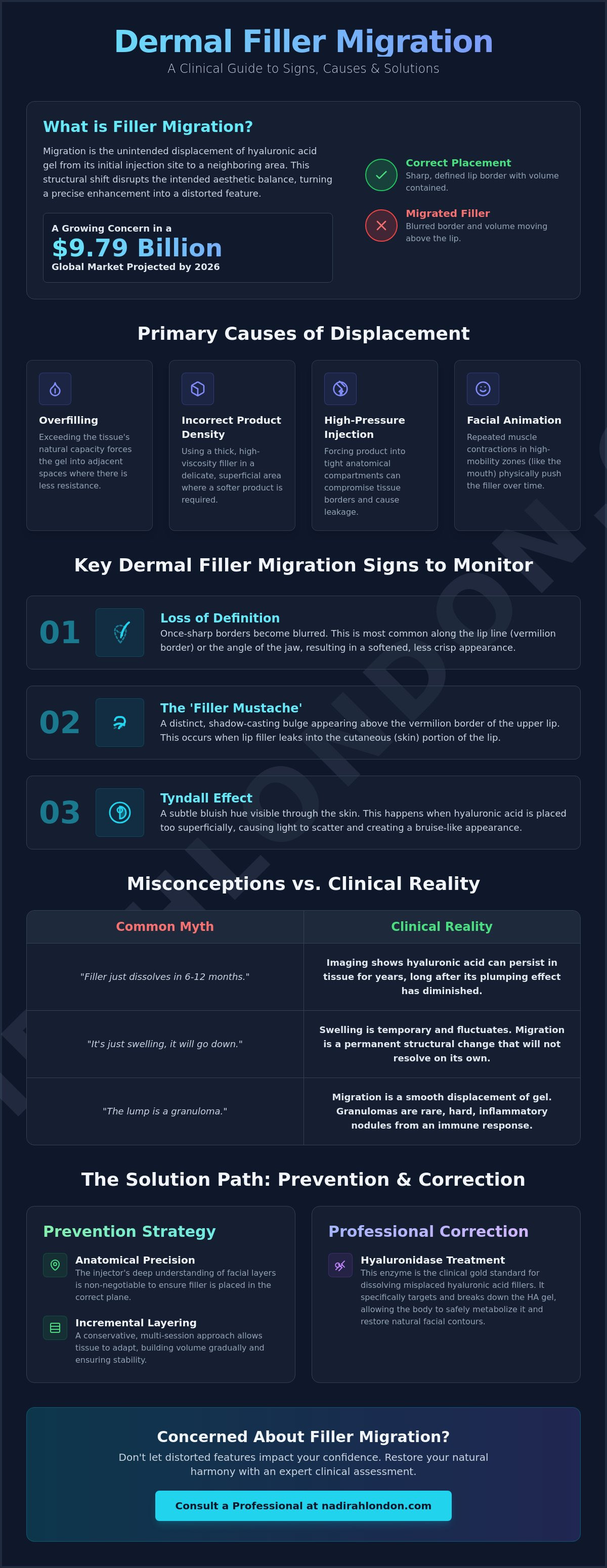
Dermal filler migration is the unintended displacement of hyaluronic acid gel from its initial anatomical plane to a neighboring region. It represents a structural shift that disrupts the intended aesthetic balance. According to this Injectable filler overview, these substances are designed for specific tissue integration. When they move, it's often due to a combination of physiological pressure and technical application errors. This displacement isn't just a minor cosmetic flaw; it's a clinical failure of product stability.
The belief that filler disappears within six to twelve months is a common myth. Clinical evidence and recent imaging demonstrate that hyaluronic acid can persist in the tissue for years. This long-term presence, combined with constant facial muscle movement, allows product to slowly migrate along the path of least resistance. Identifying dermal filler migration signs early is crucial for maintaining a refined, high-end appearance and preventing permanent distortion of your natural features.
To better understand the visual indicators of this concept, watch this helpful video:
Several primary factors contribute to this displacement:
Overfilling: Exceeding the tissue's natural capacity forces the gel into adjacent spaces.
Incorrect Product Density: Utilizing high-viscosity fillers in delicate, superficial areas.
High-Pressure Injection Techniques: Forcing product into tight anatomical compartments can compromise tissue borders.
Facial Animation: Repeated muscle contractions in high-mobility zones, like the mouth, physically push the filler over time.
The Science of Product Displacement
Hyaluronic acid is inherently hydrophilic, meaning it attracts and binds to water. This property can cause localized volume shifts if the filler isn't anchored correctly within the tissue. Injecting into the wrong tissue layer is a frequent error. Placing a deep, structural filler too superficially creates a visible shelf or bulge. Advanced procedures like "Russian Lips" demand extreme precision. Without expert control of the vermilion border, product can easily leak into the cutaneous lip, causing the dreaded "filler mustache."
Common Misconceptions vs. Clinical Reality
Clinical reality often differs from social media advice. It's vital to distinguish between late-stage swelling and true dermal filler migration signs. Swelling is typically transient and fluctuates with hydration or salt intake. Migration is a permanent structural change. The timeline for "natural dissolving" is also significantly longer than the standard 6-12 month marketing cycle suggest. Finally, migration shouldn't be confused with granulomas. While migration is a smooth displacement of volume, granulomas are hard, localized nodules resulting from an immune response.
5 Key Dermal Filler Migration Signs to Monitor
Identifying the early stages of displacement requires a keen eye for anatomical detail. While some changes are subtle, others significantly disrupt facial harmony. Recognizing dermal filler migration signs is the first step toward restoring your aesthetic proportions. Professional observation focuses on how the product interacts with your natural features in both static and dynamic states. If you suspect your filler has shifted, seeking an assessment at Nadirah London can help clarify your next steps.
There are five primary indicators that suggest your injectable has moved from its intended plane:
Loss of Definition: A blurring of once-sharp borders, particularly along the lip line or the mandibular angle of the jaw.
The 'Filler Mustache': A distinct, shadow-casting bulge appearing above the vermilion border of the upper lip.
Tyndall Effect: A subtle bluish hue visible through the skin surface. This occurs when hyaluronic acid is placed too superficially or migrates into the upper dermis, causing light to scatter. Clinical research on dermal filler displacement highlights this scattering as a key diagnostic marker.
Unnatural Projections: The appearance of "shelving" or horizontal ridges that become prominent when the face is in motion.
Palpable Hardness: The presence of firm, rope-like tracks of product in areas that should remain soft and pliable.
Visual Cues in Static and Active States
Static observation only tells half the story. Performing a "smile test" is essential for checking cheek filler stability. If the product bunches into unnatural spheres or creates a sharp ridge near the nose during animation, it has likely migrated. In the tear trough area, look for a "shelf" effect that doesn't align with the natural orbital rim. Migrating mid-face filler can also manifest as unexplained "heaviness" in the lower face, causing the jowls to appear more prominent than they were prior to treatment.
Tactile Assessment: What You Can Feel
Your sense of touch provides critical data. Use a gentle "squeeze test" along the lip border to check for integrity. If the tissue feels thick or "gummy" above the actual lip line, the product has escaped its boundary. It's important to distinguish between migrated pockets and natural fat pads; filler migration often feels more localized and has a different elasticity than biological tissue. Palpation serves as the primary clinical tool for detecting deep migration through direct tactile feedback.
Area-Specific Symptoms: From Lips to Tear Troughs
Understanding dermal filler migration signs requires a regional approach to facial anatomy. Displacement doesn't look the same in the lips as it does in the tear troughs or jawline. Each area presents unique clinical markers that signal a loss of aesthetic integrity. While social media often focuses on obvious lip distortions, subtle shifts in the mid-face and lower face can be equally damaging to your overall facial harmony. Precision in identifying these symptoms is the first step toward a successful correction plan.
Clinical studies exploring the mechanisms of filler migration indicate that product movement is often a result of local muscle activity, tissue pressure, and incorrect depth of placement. Identifying these regional symptoms early allows for more targeted intervention.
Lip Migration: A protrusion of the "white roll" above the lip and a flattening of the once-sharp Cupid's bow definition.
Tear Trough Migration: Persistent puffiness or the formation of "malar bags" that appear significantly more severe in the morning due to fluid retention.
Cheek Migration: Downward shifting toward the nasolabial folds, which paradoxically deepens the smile lines you intended to soften.
Jawline & Chin Migration: A widening effect along the mandibular border that creates a heavy, jowl-like appearance. This replaces a sharp, high-end edge with a square, bottom-heavy facial profile.
The 'Filler Mustache' Explained
The space between the nose and the upper lip border is the most frequent site for displacement. This occurs when the pink vermilion tissue is over-volumised beyond its natural capacity, forcing the hyaluronic acid gel into the cutaneous lip. Poorly executed "Russian Lip" techniques are a primary culprit. They often disrupt the structural philtrum columns and blur the transition between the lip and the surrounding skin. This creates a shelf that catches the light, resulting in a shadow often referred to as a filler mustache. It's a clear indicator that the product has escaped its intended anatomical compartment.
Mid-Face and Under-Eye Complications
Tear trough filler is particularly susceptible to complications due to the extreme thinness of the overlying skin and complex underlying vascularity. Migration in this delicate zone often leads to lymphatic blockage, causing chronic fluid retention and persistent morning edema. This is clinically distinct from natural eye bags; migrated filler typically presents as a translucent or puffy ridge that doesn't follow natural orbital contours. In the cheeks, malar filler can move inferiorly toward the mouth. This creates a "chipmunk" look that obscures the natural zygomatic arch and adds unnecessary weight to the mid-face. Recognizing these dermal filler migration signs is essential to avoiding a heavy, aged appearance.
Professional Prevention: How Expert Technique Minimises Risk
Aesthetic excellence is built on clinical precision, not chance. Preventing dermal filler migration signs requires a sophisticated understanding of anatomical boundaries and product rheology. When displacement occurs, it's frequently the result of technical errors rather than biological unpredictability. Advanced practitioners prioritise structural integrity over immediate, aggressive volumisation. This commitment to technique ensures that results remain elegant and stable over time.
Expert prevention relies on several core clinical pillars:
Incremental Layering: Small, multiple sessions are significantly safer than "one-and-done" overfilling. This allows the tissue to accommodate the product without reaching a saturation point that forces migration.
Anatomical Depth: Injecting into the correct plane is critical. Supraperiosteal placement provides structural support against the bone, while subcutaneous placement is reserved for superficial refinement.
G-Prime Matching: Selecting a filler with the appropriate elastic modulus (G-Prime) for the specific facial zone. High-density gels provide lift in the cheeks, while low-density gels maintain softness in the lips.
The Nadirah London Standard: Training practitioners to identify "at-risk" anatomy, such as thin dermal layers or high-mobility muscle zones, before the first injection.
The Role of High-Quality Training
Expertise is developed through rigorous clinical education. Our Aesthetic Training Courses teach practitioners how to master complication management and identify facial "danger zones." Understanding these high-risk areas is essential for every injector. We've seen a significant shift toward "Micro-droplet" techniques. By placing minute quantities of product in strategic patterns, injectors can ensure maximum stability. This prevents the gel from merging into a single mobile mass that is prone to shifting during facial animation.
Patient Aftercare and Responsibility
Clinical skill must be matched by patient diligence. Avoiding excessive handling or vigorous massage in the first 48 hours is vital. Manual pressure can easily push fresh, unintegrated filler into adjacent tissue planes. Sleeping positions also play a role; avoiding direct pressure on the treated area for several nights helps maintain the intended placement. We recommend scheduling regular maintenance reviews instead of seeking aggressive top-ups. This proactive approach identifies early dermal filler migration signs before they become visible distortions. Precision is the foundation of a sophisticated aesthetic. For professional results that prioritise your natural harmony, visit Nadirah London.
Correcting Migrated Filler: Dissolving and Re-Treatment
Once dermal filler migration signs are clinically confirmed, the objective shifts from observation to professional resolution. Restoration of your aesthetic integrity requires a systematic approach to removing the displaced gel. Hyaluronidase serves as the gold standard enzyme for this process. It's a concentrated biological catalyst that specifically targets the cross-linked bonds of hyaluronic acid. This intervention allows the body to naturally metabolise the migrated product, clearing the tissue for future refinement.
The dissolving protocol involves several critical stages to ensure safety and precision:
Mandatory Patch Test: A small intradermal injection on the forearm is required to rule out hypersensitivity before facial application.
Targeted Enzyme Delivery: Micro-injections are placed directly into the migrated pockets to ensure the enzyme interacts only with the displaced gel.
Immediate Visual Softening: While some breakdown occurs instantly, the full enzymatic effect typically stabilises over 48 hours.
The 14-Day Rule: A minimum wait period of two weeks is essential before any re-treatment to ensure the enzyme has fully dissipated.
The Nadirah London Correction Protocol
Our clinical philosophy focuses on "cleaning the canvas." We don't recommend layering new product over old, displaced filler. This stacking effect is a primary cause of further distortion. Managing expectations during the "deflation" phase is a key part of our service. As the filler dissolves, you'll see your natural anatomical contours return. For those who want to maintain a youthful glow without the volume risks, Skin Boosters or BioFillers provide a sophisticated alternative. These treatments focus on tissue quality and hydration rather than structural volumisation.
Restoring Facial Harmony
A refined aesthetic relies on a "less is more" approach. The goal of correction is to enhance your natural features, not mask them under excessive product. Achieving this requires a combination of clinical skill and a keen eye for proportion. We often integrate the correction process with Advanced Facials to improve skin elasticity and overall health. This ensures the skin is in peak condition for any future, precision-placed injectables. If you're concerned about your previous results, Book a consultation at Nadirah London for an expert assessment and a bespoke restoration plan.
Restoring Your Aesthetic Integrity through Clinical Expertise
Facial harmony is a delicate balance of anatomical precision and aesthetic artistry. Identifying dermal filler migration signs early is essential for maintaining the sophisticated results you desire. Movement of product doesn't have to mean permanent distortion. It's a signal that your injectable strategy requires a professional reset. By prioritizing technical accuracy and incremental layering, you can ensure your features remain sharp, defined, and naturally elevated.
Our expert clinical team in Greater London operates as an Accredited Aesthetic Training Academy, setting the industry standard for safety and results. We're recognized specialists in Russian Lip correction and complex facial restoration. We focus on "cleaning the canvas" to restore balance before any new enhancement begins. You deserve a treatment plan that respects your unique anatomy and delivers high-impact, refined outcomes.
Regain confidence in your reflection. Book a Professional Filler Assessment at Nadirah London to begin your journey toward restored facial harmony. Your transformation starts with clinical precision.
Frequently Asked Questions
Can migrated filler go away on its own over time?
No, migrated filler rarely resolves without professional intervention. Clinical evidence shows that hyaluronic acid can persist in the tissue for years, often remaining visible long after the expected metabolic window. Professional dissolving is required to clear the displaced product and restore natural facial proportions. Leaving it to "wear off" often results in prolonged aesthetic distortion and potential tissue stretching.
Is it possible to massage migrated lip filler back into place?
You should never attempt to manually massage migrated filler back into its original position. Applying pressure can exacerbate the displacement by forcing the hyaluronic acid gel deeper into adjacent tissue planes or across anatomical borders. This often worsens the visual distortion and makes professional correction more difficult. Only a clinical practitioner should handle the product to ensure tissue integrity is maintained.
How can I tell the difference between migration and a normal lump?
Migration involves a structural shift of volume across anatomical borders, while a normal lump is typically a localized, stationary deposit. Identifying dermal filler migration signs requires looking for blurred edges or shadows, such as the "filler mustache," rather than isolated nodules. Lumps are often the result of poor integration, whereas migration represents a total failure of the product to stay in its intended plane.
Does dissolving filler with hyaluronidase damage my natural skin?
No, hyaluronidase does not damage your natural skin structure when administered correctly by a specialist. It's a targeted enzyme that primarily breaks down the cross-linked bonds of injected hyaluronic acid. While it may temporarily interact with your body’s natural HA, your skin typically replenishes these levels within 24 to 48 hours. This treatment is an essential tool for restoring facial harmony after displacement without causing permanent dermal harm.
How soon after dissolving migrated filler can I get new injections?
You must wait a minimum of 14 days after a dissolving treatment before receiving new injections. This two-week window ensures that the hyaluronidase has completely dissipated from the tissue. If you re-inject too soon, any residual enzyme will immediately break down your new filler. This waiting period also allows localized swelling to subside, providing a clear "canvas" for precision-placed results.
What happens if I leave migrated filler untreated?
Untreated migration can lead to permanent tissue stretching and chronic lymphatic issues. In delicate areas like the tear troughs, displaced product often causes persistent morning edema and "malar bags" that worsen over time. The longer the product remains in the wrong anatomical plane, the more it can stretch the overlying skin, potentially requiring more complex intervention to restore a youthful appearance.
Are certain types of filler more likely to migrate than others?
Yes, high-viscosity fillers placed too superficially and low-G-prime fillers used in high-mobility areas are significantly more prone to movement. Selecting the correct product density for each specific anatomical zone is a critical factor in preventing dermal filler migration signs. Professional injectors prioritize matching the filler’s rheology to the tissue's natural elasticity to ensure long-term stability and a refined, high-end finish that remains in place.
Can migration happen years after the original treatment?
Yes, migration can occur several years after the initial injection due to cumulative muscle movement and natural aging. Hyaluronic acid is often more persistent than the standard 6 to 12-month marketing cycle suggests. Constant facial animation can slowly push the gel along the path of least resistance, leading to a gradual loss of definition that only becomes noticeable years later. This long-term displacement requires professional assessment to correct.


Comments