

Complications Management in Aesthetics Course UK: Mastering Clinical Safety 2026

Updated: Jun 30
Would your clinical reputation survive a vascular occlusion on a Friday afternoon without a proven protocol in hand? You understand that while dermal fillers and anti-wrinkle injections offer transformative results, the fear of necrosis or anaphylaxis remains a silent weight on your shoulders. It's natural to feel the pressure of meeting strict new licensing requirements and securing essential CPD points. Our guide to the definitive complications management in aesthetics course UK empowers you to master the skills needed to identify, manage, and reverse aesthetic complications with absolute clinical precision.
Full confidence in identifying vascular occlusion. Mastery of elective and emergency dissolving. Step-by-step emergency protocols. We provide the roadmap to securing your accredited CPD certification for the 2026 national licensing scheme. From navigating complex hyaluronidase protocols to handling anaphylaxis without hesitation, this overview ensures your practice remains a premium, safe, and elite destination for aesthetic transformation. It's time to replace clinical anxiety with the authoritative expertise your patients demand.
Table of Contents
Why Complications Management is the Foundation of Advanced Aesthetic Practice
Core Curriculum: Identifying and Reversing Vascular and Non-Vascular Issues
The Critical Difference Between Online Theory and Clinical Competency
Establishing Gold-Standard Emergency Protocols in Your Clinic
Professional Training at Nadirah London Beauty Clinic & Academy: Elevating Practitioner Standards
Why Complications Management is the Foundation of Advanced Aesthetic Practice
Clinical excellence is defined by the ability to manage the unexpected. In the sophisticated landscape of 2026, complications management is the clinical bedrock of any elite practice. Under the Health and Care Act 2022, the UK government has mandated a national licensing scheme in England starting July 2026. This transition shifts the industry from an unregulated market to a professional environment where precision is paramount. Completing a complications management in aesthetics course UK ensures you meet these rigorous registration standards while protecting your patients and your professional standing.
The professional shift from "if" to "when" marks the transition from a technician to a master practitioner. Even at the highest levels of medical intervention, practitioners must account for Plastic surgery risks and complications to maintain safety. Mastery of these protocols isn't just about avoiding disaster; it's about the clinical precision required to handle vascular compromise or anaphylaxis with absolute confidence. This expertise is a prerequisite for securing comprehensive insurance coverage for dermal fillers and anti-wrinkle injections.
To better understand this concept, watch this helpful video:
The Evolving Regulatory Landscape in the UK
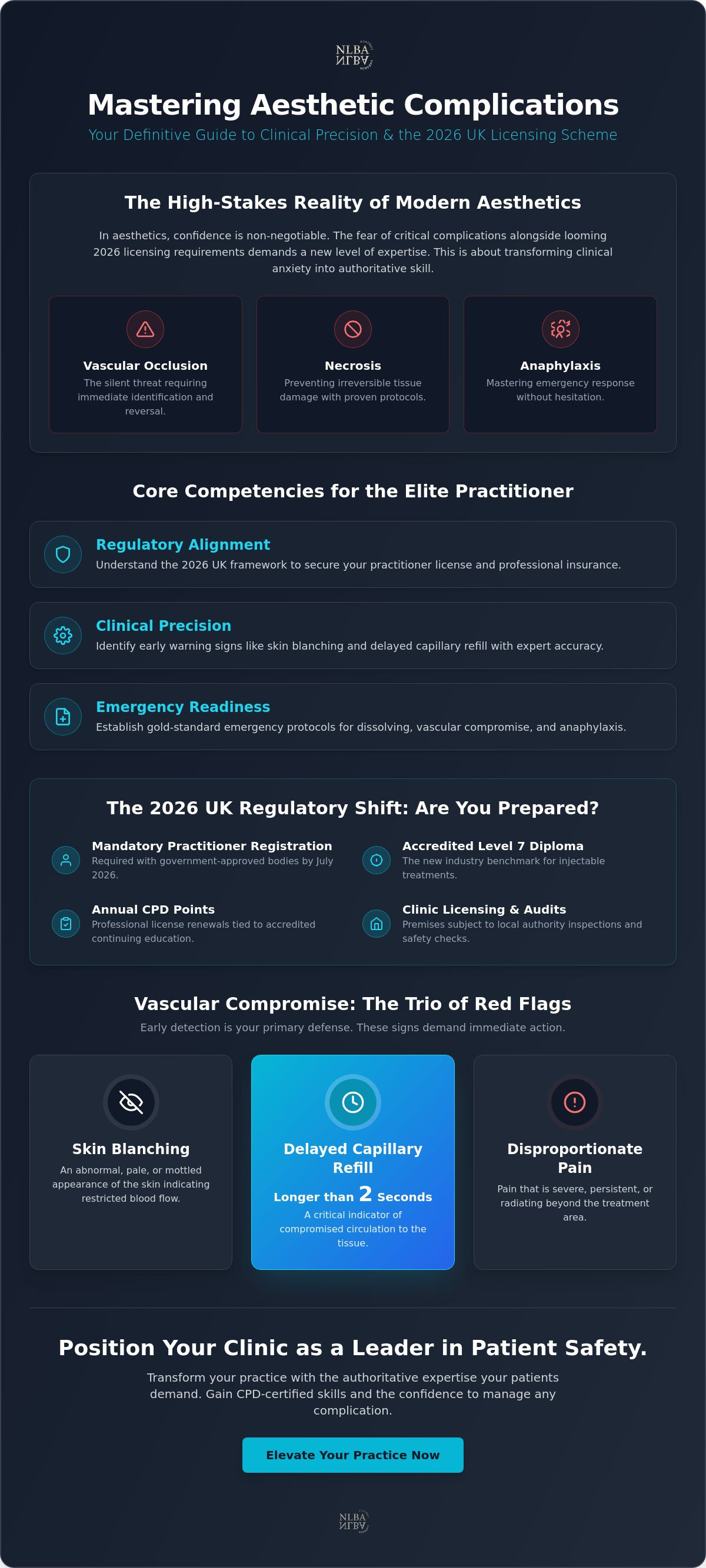
The 2026 standards require more than a basic understanding of bruising or swelling. Practitioners must now demonstrate high-level competency aligned with JCCP and CPSA guidelines. Key requirements include:
Mandatory practitioner registration with government-approved bodies by July 2026.
Accredited Level 7 Diploma qualifications as the industry benchmark for injectables.
Annual professional license renewals tied to accredited CPD points.
Clinic licensing subject to local authority inspections and safety audits.
As these standards become the industry benchmark, practitioners are seeking out established academies to ensure their clinical skills are up to date. For example, Inspired Cosmetic Training provides professional education in medical aesthetics designed to help clinicians navigate these new regulatory demands safely and effectively across the UK.
Safety as a Luxury Brand Differentiator
Positioning your clinic as a safety-first destination is a powerful strategy for attracting high-end London clients. In a market where results are expected, clinical safety becomes the ultimate luxury differentiator. Transparent protocols don't scare patients; they build immense trust. When you can articulate exactly how you handle rare adverse events, you demonstrate a level of sophistication that increases patient conversion and long-term loyalty. Your confidence during the consultation directly impacts the overall patient experience, transforming a standard procedure into an indulgent, secure journey of self-care. It's about delivering high-impact results with the peace of mind that only elite training provides.
Core Curriculum: Identifying and Reversing Vascular and Non-Vascular Issues
Effective practice requires a structured hierarchy of clinical awareness. Complications range from expected minor bruising to critical vascular compromise. A high-tier complications management in aesthetics course UK focuses on immediate recognition. Early detection markers are your primary defense. Skin blanching, an abnormal capillary refill test (longer than 2 seconds), and disproportionate pain are the trio of red flags. These indicators distinguish a standard post-treatment response from a developing ischaemic event. Aligning your clinical judgment with GMC guidance on cosmetic interventions ensures you maintain the highest professional standards when these markers appear.
Differentiating between normal swelling and delayed-onset inflammatory nodules is a hallmark of the advanced practitioner. Swelling is immediate and symmetrical. Nodules often appear weeks or months later; they signal a potential biofilm or hypersensitivity. Understanding the science of hyaluronidase is essential for resolution. This enzyme breaks down hyaluronic acid cross-links, allowing for rapid filler dispersal. Whether for elective aesthetic refinement or an emergency reversal, mastery of dosage and reconstitution is non-negotiable for clinical safety.
Vascular Occlusion (VO) and Ischaemia Mastery
Vascular occlusion demands immediate, aggressive intervention. Practitioners must identify the stages of necrosis, from livedo reticularis to skin breakdown, to prevent permanent tissue loss. The high-dose pulsed hyalase technique is the current gold standard for VO management. This protocol involves injecting high concentrations of hyaluronidase into the affected area every hour until capillary refill returns. While rare, the risk of filler-induced blindness remains a critical concern. Elite training covers the anatomical pathways and emergency referral steps necessary to mitigate this catastrophic outcome.
Non-Vascular Adverse Events and Patient Psychology
Managing non-vascular events requires a blend of clinical expertise and psychological management. Accurate identification of Type I anaphylaxis versus Type IV hypersensitivity is vital for correct pharmaceutical intervention. Biofilms and late-onset inflammatory nodules (LIONs) require specialized antibiotic or steroid protocols. The technical reversal is only half the battle. Your ability to keep the client calm during a crisis is a defining trait of an authoritative professional. Maintaining a steady, business-like demeanor while executing reversal protocols prevents panic and preserves the patient relationship. If you're ready to elevate your clinical safety, explore our aesthetic training courses designed for the modern practitioner.
The Critical Difference Between Online Theory and Clinical Competency
Theory serves as the cognitive blueprint. It provides the necessary definitions and protocols. However, it's not the final destination for a practitioner aiming for elite status. A complications management in aesthetics course UK requires a transition from digital screens to clinical environments. While online CPD is an excellent tool for refreshing knowledge or reviewing hyaluronidase reconstitution ratios, it cannot replicate the high-stakes environment of a live clinical reversal. Digital modules provide the framework; clinical suites provide the mastery.
Clinical competency is built on tactile feedback and real-time decision-making. Understanding your Scope of Practice means knowing when your digital training ends and where hands-on expertise must begin. UK aesthetic training standards increasingly emphasize that practitioners shouldn't perform procedures they haven't practiced in a supervised, physical setting. This ensures that when a crisis occurs, your response is instinctive rather than academic. It's the difference between knowing what to do and having the muscle memory to do it.
The Limitations of Digital Learning in Aesthetics
Digital learning has inherent boundaries that can't be bypassed. You cannot master the specific pressure required for therapeutic massage or the nuances of heat application through a screen. Key limitations include:
Sensory gaps. The inability to feel tissue resistance or identify the specific texture of a late-onset inflammatory nodule.
Visual limitations. Missing the subtle, three-dimensional shifts in skin tone and perfusion during a live capillary refill test.
Provider quality. The vital distinction between "Recognised" courses, which often only track attendance, and "Accredited" qualifications that assess actual clinical skill.
Hands-On Progression at Nadirah London Beauty Clinic & Academy
Nadirah London Beauty Clinic & Academy bridges the gap between theory and high-end clinical execution. Our supervised practical sessions are designed to build the muscle memory essential for emergency intervention. Transitioning from a Level 3 or 4 base to advanced injectable procedures requires more than just a certificate; it requires a mentor. Having a senior practitioner provide emergency support during your initial cases is the ultimate safety net for any results-driven professional. Our aesthetic training courses focus on this progression, ensuring you move from a foundational understanding to the authoritative confidence of a clinical expert. Mastery is found in the clinical suite, where precision meets professional accountability.
Establishing Gold-Standard Emergency Protocols in Your Clinic
Operationalizing clinical safety is the final step in mastering your practice. Integrating protocols from a complications management in aesthetics course UK into your daily operations transforms your clinic from a treatment room into a high-end medical environment. A culture of safety relies on the No-Blame approach. This ensures every minor deviation is reported and analyzed without fear; preventing small issues from becoming irreversible damage. In the 2026 regulatory environment, these protocols are the hallmark of a results-driven professional.
Standard Operating Procedures (SOPs) must be accessible and practiced. Every common aesthetic emergency requires a dedicated pathway:
Vascular Occlusion. Immediate high-dose pulsed hyalase protocol.
Anaphylaxis. Rapid administration of intramuscular adrenaline.
Delayed-Onset Inflammatory Nodules (LIONs). Steroid or antibiotic intervention pathways.
Infection/Biofilm. Sterile swab and localized treatment protocols.
Legal protection begins long before a needle touches the skin. Thorough consultation and informed consent forms aren't just paperwork; they're clinical safeguards. These documents must clearly outline potential adverse events and the specific reversal steps you are trained to take. Post-complication follow-up is equally critical. Essential documentation includes high-resolution photography, time-stamped clinical notes, and a structured patient aftercare plan that monitors the resolution of the event.
The Ultimate Aesthetic Emergency Kit Checklist
A gold-standard kit is the physical manifestation of your clinical readiness. It must be organized, current, and accessible to all staff. Essential components include:
Hyaluronidase. Minimum of 10 vials (1500 units each) for emergency reversal.
Adrenaline (EpiPen). Two auto-injectors (0.3mg) for immediate Type I hypersensitivity management.
Aspirin. 300mg tablets to be administered immediately in cases of suspected VO to inhibit platelet aggregation.
Topical Vasodilators. Glyceryl Trinitrate (GTN) patches or ointment to promote localized blood flow.
Ancillary Supplies. Instant heat packs, sterile 27G/30G needles, and sodium chloride for reconstitution.
Maintenance protocols are mandatory. Checking expiry dates and storage requirements for reversal agents should be a monthly clinical audit task. This level of efficiency ensures that when a crisis occurs, your equipment is as prepared as your mind.
Documentation and Referral Pathways
Writing a clinical incident report is a skill that protects your professional practice. The report must be objective, chronological, and detailed. It should document the onset of symptoms, the specific intervention used, and the patient's response. Establishing a formal relationship with a local prescribing lead or a specialist ophthalmologist is a prerequisite for advanced practice. You must have clear criteria for escalation. If vision is affected or if a systemic reaction doesn't stabilize, a 999 or A&E referral is the only acceptable path. To ensure your clinic meets these elite standards, explore our aesthetic training courses and secure your clinical reputation.
Professional Training at Nadirah London Beauty Clinic & Academy: Elevating Practitioner Standards
Nadirah London Beauty Clinic & Academy operates at the intersection of high-end clinical service and elite aesthetic education. For the practitioner seeking to transcend the role of a technician, our complications management in aesthetics course UK provides the necessary clinical weight. We believe that mastery of adverse events is the ultimate hallmark of a luxury brand. By training within an active, high-volume London clinic, you witness the seamless integration of safety protocols into a premium patient journey. Our educators are active specialists who navigate the complexities of modern aesthetics daily, ensuring your training is grounded in current, results-driven practice.
Why Train With Nadirah London Beauty Clinic & Academy?
Advanced procedural mastery. Direct access to the latest techniques in dermal fillers and anti-wrinkle injections utilized in our own luxury treatment suites.
Revenue-focused training. Developing the clinical confidence that allows for the safe expansion of high-value services like Liquid BBL or BioFiller.
Premium clinical environment. Learning within a setting that reflects the expectations of a sophisticated, high-end clientele.
Supportive mentorship. Moving from online theory to in-person clinical mastery with the guidance of senior practitioners who prioritize precision.
Enrolling in the Complications Management Module
Your professional training journey is designed for maximum clinical impact. The complications module functions as a critical safety layer that can be combined with our advanced filler masterclasses or skin specialist courses. This holistic approach ensures you aren't just placing product; you're managing complete patient care. Explore our accredited aesthetic courses at Nadirah London Beauty Clinic & Academy to secure your clinical reputation in the 2026 landscape. Elevate your practice by choosing a destination where clinical excellence and luxury aesthetic results are non-negotiable standards.
Securing Your Clinical Authority for 2026
The transition to a regulated UK aesthetic market in July 2026 is a defining moment for practitioners. Mastering clinical safety isn't just about risk mitigation; it's about establishing your practice as an elite, high-trust destination. You've explored the necessity of gold-standard emergency protocols and the critical gap between digital theory and hands-on clinical competency. By enrolling in a complications management in aesthetics course UK, you ensure your skills are aligned with the highest professional standards and government-approved licensing requirements.
At Nadirah London Beauty Clinic & Academy, we offer a unique training environment. Our courses are accredited by leading UK awarding bodies and taught by active London aesthetic specialists. You'll gain practical experience within a luxury clinic-based training environment, moving beyond the needle to deliver complete patient care. It's time to elevate your practitioner standards and secure your clinical reputation for the future.
View Our Accredited Aesthetic Training Courses and take the final step toward professional mastery. Your journey to becoming an authoritative clinical expert starts here.
Frequently Asked Questions
Is a complications management course mandatory for aesthetic practitioners in the UK?
Registration and accreditation will become mandatory for all practitioners in England from July 2026 under the new national licensing scheme. This legislation, introduced via the Health and Care Act 2022, requires practitioners to hold recognized, accredited qualifications to legally perform injectables. Holding a valid certificate in complications management is a fundamental requirement for both government registration and professional indemnity insurance.
What is the most common complication in dermal filler treatments?
Minor bruising and localized swelling are the most frequent post-procedural occurrences in daily practice. From a clinical management perspective, practitioners most commonly treat delayed-onset inflammatory nodules or aesthetic dissatisfaction requiring elective dissolving. While vascular occlusion is rarer, its severity makes it the most critical complication to master within any professional training framework.
Do online complications courses provide enough CPD points for insurance?
Online theory courses provide essential CPD points for annual professional development; however, they are often viewed as a starting point rather than a final qualification. Most premium insurers require evidence of practical, hands-on competency for full coverage. A comprehensive complications management in aesthetics course UK that combines digital theory with supervised clinical sessions is the gold standard for securing robust insurance terms.
What should be included in an aesthetic emergency kit?
A professional emergency kit must contain a minimum of 10 vials of hyaluronidase (1500 units each) and two adrenaline auto-injectors (0.3mg). You should also include 300mg aspirin tablets, glyceryl trinitrate (GTN) patches, and instant heat packs. Maintaining sterile saline for reconstitution and an assortment of 27G and 30G needles ensures you are prepared for immediate intervention.
Can non-medics take a complications management course in the UK?
Yes, non-medical practitioners can enroll if they meet the specific entry requirements, such as a Level 3 or 4 qualification in Beauty Therapy or equivalent clinical experience. The 2026 regulatory framework focuses on accredited competency and practitioner registration rather than previous professional background. This ensures all individuals performing high-impact procedures meet the same rigorous safety and clinical standards.
How often should I refresh my complications management training?
Annual refreshers are the industry benchmark for maintaining clinical precision and high-level safety standards. Regular training ensures you remain current with evolving protocols, such as the high-dose pulsed hyalase technique and updated JCCP guidelines. Continuous learning is a key requirement for the annual renewal of your professional license under the 2026 UK regulations.
What is the difference between elective and emergency filler dissolving?
Elective dissolving is a controlled procedure used to correct overfilling, migration, or patient dissatisfaction with their aesthetic result. Emergency dissolving is a rapid, high-concentration intervention triggered by suspected vascular compromise or ischaemia. While elective work prioritizes aesthetic refinement, emergency protocols focus entirely on restoring blood flow and preventing permanent tissue necrosis.
How do I identify a vascular occlusion immediately after injecting?
Immediate identification relies on three primary clinical markers: localized skin blanching, disproportionate patient pain, and a delayed capillary refill test exceeding two seconds. You may also observe a livedo reticularis pattern, which appears as a dusky, mottled discoloration of the skin. Mastering these visual cues during a complications management in aesthetics course UK is essential for preventing long-term tissue damage.


Comments