

Aesthetics Courses for Non-Medics London: The 2026 Buying Guide

Updated: Jun 10
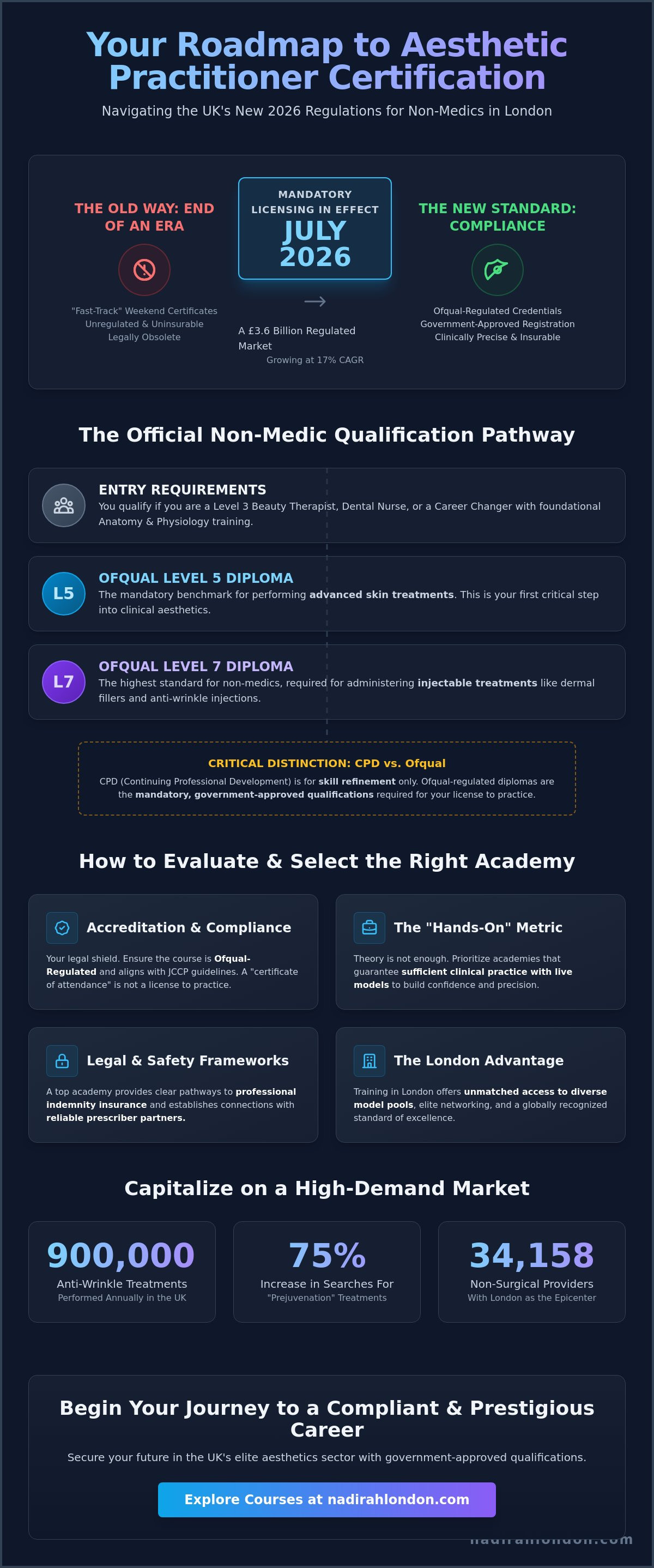
The era of the "fast-track" weekend certificate is officially dead. With the UK's mandatory licensing scheme now in full effect as of July 2026, entering the £3.6 billion aesthetics market requires more than just a passion for beauty. It demands clinical precision, government-approved registration, and Ofqual-regulated credentials. You likely feel the weight of these new regulations. The confusion surrounding Level 7 requirements and the fear of insurance rejection can make starting your career feel like a legal minefield. Finding the most reputable aesthetics courses for non-medics London provides is now the only viable way to protect your professional future.
This guide clarifies your path to professional excellence. You'll discover the most prestigious pathways to becoming a certified practitioner, ensuring you meet the strict new standards for dermal fillers and anti-wrinkle injections. We'll preview the essential qualification tiers, hands-on training protocols, and the specific steps to building a high-end career in London's elite beauty sector. Expect a clear, results-driven roadmap to becoming a certified, confident, and fully compliant aesthetic practitioner in this new regulatory era.
Key Takeaways
Navigate the mandatory July 2026 UK licensing scheme to secure your legal status as an accredited practitioner.
Identify the most prestigious aesthetics courses for non-medics London provides, focusing on Ofqual-regulated Level 5 and Level 7 certifications.
Evaluate training academies using the "Hands-On" metric to ensure sufficient clinical practice with live models.
Establish essential legal frameworks, including professional indemnity insurance and reliable prescriber partnerships for injectable treatments.
Leverage the dual advantage of training within active, high-end London clinics to master luxury service standards.
Table of Contents
The Landscape of Aesthetics Training for Non-Medics in London
The UK aesthetics sector is no longer an unregulated frontier. Following the legislative shifts of 2026, the industry has evolved into a sophisticated clinical discipline. This evolution marks the end of the traditional "beauty therapist" label for those entering the high-stakes world of Aesthetic medicine. Practitioners now operate as clinical specialists, focusing on transformative outcomes through technical precision and anatomical expertise. Professionalizing your approach is essential to thrive in a market currently growing at a CAGR of 17%.
To better understand the requirements for entering this field safely and effectively, watch this helpful video:
Choosing the right aesthetics courses for non-medics London provides is the first step toward capturing a share of the capital's elite market. It's a transition from surface-level pampering to advanced, results-driven care. With over 900,000 Botox treatments performed annually in the UK, the demand for qualified, non-medical practitioners has never been higher, provided they hold the correct credentials.
Defining the Non-Medic Pathway in 2026
The pathway to becoming a certified practitioner is now clearly defined for several professional backgrounds. You qualify for this transition if you are a Level 3 beauty therapist, a dental nurse, or a career changer willing to complete the necessary foundational anatomy and physiology training. The 2026 regulations require a strict distinction between CPD and Ofqual-regulated qualifications. While CPD is excellent for skill refinement, Ofqual Level 5 and Level 7 diplomas are the mandatory benchmarks for advanced skin treatments and injectables. The Pathway is a structured educational progression that moves practitioners from foundational skin health to advanced dermal fillers and anti-wrinkle injections through rigorous clinical assessment.
Why Training in London Offers a Competitive Edge
London is the epicenter of the UK’s 34,158 non-surgical providers, offering a level of exposure you won't find elsewhere. Students attending aesthetics courses for non-medics London academies benefit from a fast-paced, high-end environment that mirrors the expectations of a luxury clientele. Training in the capital offers specific advantages:
Diverse Model Pools: Unmatched access to varied skin types and facial structures for essential hands-on practice.
Elite Networking: Immediate proximity to the world's most concentrated market of luxury clinics and professional prescribers.
Global Prestige: Academy certifications from London carry significant weight, signaling a high standard of clinical precision to potential employers and clients.
Practitioners in the city are uniquely positioned to capitalize on the "prejuvenation" trend, with a 75% increase in searches for preventative treatments among younger demographics. This ensures your training is both clinically deep and commercially relevant.
How to Evaluate Aesthetic Courses: A Selection Framework
Selecting your academy is a strategic business decision that dictates your long-term clinical safety. In the wake of recent licensing mandates, the criteria for aesthetics courses for non-medics London has shifted from simple price-point comparisons to rigorous clinical depth. You need a framework that prioritizes insurance-backed certification over basic attendance certificates. The distinction between a "certificate of attendance" and a "license to practice" is the difference between a thriving career and a significant legal liability.
Accreditation and Regulatory Compliance
Accreditation is your legal shield. Mapping your education against the Joint Council for Cosmetic Practitioners (JCCP) guidelines is non-negotiable for practitioners in the capital. While many courses claim to be "accredited," this often refers to CPD (Continuing Professional Development) points rather than the Ofqual-regulated status required for mandatory licensing. Always verify with your insurance provider that they recognize the specific academy before committing. Most insurers now require proof of a Level 5 or Level 7 pathway for injectable coverage, with professional indemnity insurance typically costing between £100 and £300 per year.
Practical Training vs. Theory-Based Learning
Theory provides the foundation; practice builds the practitioner. A superior curriculum balances anatomical science with intensive live-model injecting. Your pre-study materials should arrive weeks in advance, covering facial nerve maps and vascular danger zones. Complications management training is the most critical component of your foundation year. You must be proficient in identifying and treating vascular occlusions before you ever treat a client. For those seeking an environment that blends clinical precision with a high-end aesthetic, exploring professional training programs at an established London clinic is the most direct route to success.
Use the following checklist to evaluate the clinical environment of any potential aesthetics courses for non-medics London provides:
Tutor Credentials: Verify instructors are active practitioners with at least three years in the luxury sector.
Model Ratios: Demand a 1:1 or 1:2 student-to-model ratio for maximum hands-on experience.
Clinical Setting: Training must occur in a sterile, CQC-compliant environment, not a hotel conference room.
Post-Course Support: Ensure there is a direct line for clinical oversight during your first six months of practice.
Understanding the hierarchy of training is essential for career progression:
Foundation: Entry-level dermal fillers and anti-wrinkle injections.
Advanced: Sculpting techniques for the jawline, chin, and temples.
Masterclass: High-impact procedures including PRP/PRF, BioFiller, and Liquid BBL.
Core Aesthetic Procedures for Non-Medical Professionals
The 2026 aesthetics market is defined by high-impact, minimally invasive results. For those enrolled in aesthetics courses for non-medics London academies host, the curriculum focuses on the industry's highest-revenue treatments. Injectables like dermal fillers and anti-wrinkle injections now account for 65% of the UK’s total aesthetics revenue. Mastery of these procedures is the primary driver of clinic profitability and practitioner reputation. It's no longer enough to offer basic services; you must provide clinical precision that rivals medical counterparts.
Anti-wrinkle injections remain the most requested treatment, with 900,000 procedures performed annually in the UK. Because botulinum toxin is a prescription-only medicine (POM), non-medical practitioners must navigate specific legal frameworks. You'll need to establish a partnership with a qualified prescriber who performs face-to-face consultations with your clients. This collaborative model ensures clinical safety while allowing you to focus on the technical administration of the product. It's a professional synergy that protects both the practitioner and the patient.
Mastering the Art of Dermal Fillers
Dermal fillers are the "bread and butter" of any successful practice. Training focuses on anatomical precision in the lips, cheeks, and jawline. You'll study product rheology to understand how different hyaluronic acid densities interact with facial tissues. Achieving the highly sought-after "Russian Lips" aesthetic requires a specific advanced certification due to the complex vertical injection techniques and increased risk of vascular compromise. Masterclass-level training also introduces BioFiller and PRP/PRF for clients seeking autologous, regenerative solutions. These advanced techniques allow for sophisticated facial sculpting that meets the high expectations of London's luxury market.
Skin Specialism: The Foundation of Injectables
Long-term client retention is built on superior skin quality. Integrating advanced facials, microneedling, and dermaplaning into your portfolio creates a comprehensive treatment plan that injectables alone cannot achieve. Before advancing to needles, you must master Anatomy and Physiology (A&P) at Level 3 and 4. These foundational skin specialist courses provide the biological knowledge required to manage complications and understand tissue response. Skin specialists often see higher retention because they address texture, tone, and elasticity alongside volume. It's about creating a canvas that enhances the results of every injectable procedure.
The demand for regenerative aesthetics and body contouring has surged in 2026. Treatments like PRP (Platelet-Rich Plasma) and Liquid BBL offer non-surgical alternatives to traditional procedures, appealing to the growing demographic of patients seeking "natural" enhancement. These advanced skills are often taught in specialized aesthetics courses for non-medics London centers, allowing you to diversify your service menu. Adding IV Vitamin Drips and fat-dissolving injections further positions your clinic as a holistic destination for physical enhancement. To see how these treatments are implemented in a professional setting, learn more about Beauty Worx Aesthetics and their approach to fat-dissolving solutions. This diversification is essential for practitioners looking to thrive in a competitive urban environment.
Legal Requirements, Insurance, and Safety Protocols
Legal compliance is the ultimate marker of a high-end practitioner. Since the introduction of the July 2026 licensing scheme, non-medics must adhere to strict clinical standards to operate legally in the capital. This involves more than just passing a test. It requires a robust legal framework that includes mandatory registration and adherence to local council hygiene standards. Choosing the right aesthetics courses for non-medics London offers is your first step toward meeting these rigorous benchmarks. Professionalism in this sector is defined by your ability to navigate these regulations with clinical precision.
One of the most significant hurdles for non-medical practitioners is the procurement of prescription-only medicines (POMs) like botulinum toxin. Legally, you cannot prescribe these yourself. You must establish a partnership with a qualified prescriber who conducts a mandatory face-to-face consultation with every client before you administer the treatment. This ensures patient safety and maintains the clinical integrity of your practice. Failing to follow this protocol is a criminal offense under the new regulations. Reliable academies often provide access to prescriber networks to help you bridge this gap.
Navigating the Insurance Maze
Securing professional indemnity insurance is a non-negotiable requirement for registration. In 2026, insurers have tightened their criteria, often requiring proof of Ofqual-regulated training for policy approval.
Hamilton Fraser: Known for extensive clinical support and aesthetic-specific policies.
Cosmetic Insure: Offers tailored packages for non-medical practitioners.
Insync Insurance: A popular choice for those starting with foundation courses.
Expect to pay between £100 and £300 per year for standard coverage. Documentation is everything. Keep digital copies of your Level 3 A&P and your specific procedure certificates to ensure seamless policy renewals. Cheapest is rarely safest; prioritize policies that include robust legal defense and complications cover.
Emergency Protocols and Complications
A true professional is defined by how they handle the unexpected. Complications management is the most critical skill you will learn. You must be trained in the use of Hyaluronidase to dissolve dermal fillers in the event of a vascular occlusion. Your emergency kit must be fully stocked with Anaphylaxis management tools, including Adrenaline auto-injectors. Building a relationship with a medical mentor provides a vital safety net, offering emergency oversight when complex issues arise. To ensure you are fully prepared for these scenarios, enrol in a certified training program that prioritizes clinical safety and emergency response.
Your clinical environment must also meet London council standards. This includes non-porous flooring, clinical waste contracts, and sharps disposal protocols. These are not merely suggestions. They are the prerequisites for the clinic licensing that local authorities now enforce with regular inspections and potential fines. Mastery of these safety protocols ensures your business is built on a foundation of trust and longevity.
Why Nadirah London Academy is the Premier Choice for Non-Medics
Success in the 2026 aesthetics market requires more than a certificate. It demands an immersion into the luxury standards that high-end clients expect. Nadirah London Academy bridges the gap between basic education and elite practice. By training within a working, high-end London clinic, you observe the nuances of client consultation and clinical precision firsthand. This is the ultimate destination for those seeking aesthetics courses for non-medics London that prioritize real-world excellence over classroom theory. You don't just learn the "how"; you master the environment where these high-impact results are achieved.
The Nadirah London Training Experience
Class sizes remain intentionally small. This ensures intimate, expert-led guidance for every student. You'll work with high-quality models provided by the academy, allowing for realistic practice on diverse facial structures. The curriculum integrates luxury service standards into every clinical procedure. From the initial greeting to post-treatment care, you learn to deliver an experience that justifies premium pricing. Our lead instructor is a Qualified Ofqual Teacher. This ensures your education meets the highest pedagogical and clinical standards required for the July 2026 licensing scheme. It's a level of authoritative instruction that builds immediate confidence.
Career Progression and Alumni Support
Learning doesn't end with your initial certification. We provide a clear pathway beyond the career launch, focusing on long-term growth and technical mastery.
Bespoke Mentorship: Direct access to practitioners active in the luxury London market.
Advanced Protocols: Master exclusive techniques including Liquid BBL, BioFiller, and PRP/PRF.
Business Marketing: Strategic guidance on positioning your brand to attract the 25 to 40-year-old demographic driving current demand.
Specialized Modules: Expand your portfolio with IV Drip training and skin specialist courses.
The Nadirah London network offers ongoing support through masterclasses. These sessions keep your skills at the cutting edge of 2026 trends, such as regenerative aesthetics and prejuvenation. You aren't just joining a course; you're entering a professional community dedicated to achieving specific, elevated results. This dual identity as both a high-end clinic and an educational hub provides an unmatched advantage. You learn from those who are currently shaping the industry. For practitioners ready to move beyond foundation levels, our advanced modules offer the technical depth needed for high-impact procedures. Whether it's mastering Anti-Wrinkle Injections or perfecting Advanced Facials, the focus remains on clinical safety and aesthetic sophistication.
Elevate Your Career in London’s Elite Aesthetics Market
Success in the modern aesthetic sector demands a fusion of clinical precision and luxury service standards. You now understand that the July 2026 licensing scheme has redefined the entry requirements for non-medical practitioners. Prioritizing aesthetics courses for non-medics London academies provide is essential for securing insurance-approved pathways and mastering complications management. By choosing an environment that offers expert-led hands-on sessions and CPD accredited training, you ensure your practice is built on a foundation of safety and sophistication.
The transition from a career changer to a certified aesthetic practitioner is a strategic investment in your professional future. Training within a luxury London clinic environment provides the technical depth and professional network needed to thrive in a competitive urban market. It's time to move beyond basic certifications and embrace a results-driven educational path that prioritizes your clinical growth.
Explore Our Accredited Aesthetics Courses for Non-Medics today to begin your transformation. The 2026 market is ready for practitioners who lead with expertise and clinical excellence.
Frequently Asked Questions
Can I really practice aesthetics in London without a medical degree?
Yes, you can practice legally provided you comply with the July 2026 UK licensing mandate. This requires non-medics to hold Ofqual-regulated qualifications, such as Level 5 for advanced skin treatments and Level 7 for injectables. Success depends on clinical competence and registration with a government-approved body rather than a traditional medical background. It's about meeting the new professional standards for safety and precision.
What is the best entry-level course for a complete beginner in aesthetics?
A foundational skin specialist course or a Level 3 Anatomy and Physiology (A&P) program is the essential starting point for any beginner. These courses provide the biological knowledge required to understand tissue response and skin health. Mastering advanced facials and microneedling first allows you to build a clinical portfolio before progressing to more complex injectable procedures like dermal fillers.
How do non-medics get a prescription for Botox in the UK?
Non-medics obtain prescriptions by partnering with a qualified healthcare professional who holds prescribing rights. The law mandates a face-to-face consultation between the prescriber and the client before any prescription-only medicine, such as Anti-Wrinkle Injections, can be administered. This collaborative model ensures patient safety and maintains the clinical integrity of your practice while fulfilling legal requirements for POM procurement.
Which aesthetic treatments are most profitable for new practitioners in London?
Dermal Fillers and Anti-Wrinkle Injections remain the most profitable core services due to high consumer demand. However, adding specialized treatments like IV Vitamin Drips, PRP/PRF, and BioFiller can significantly increase your average booking value. These regenerative procedures appeal to a luxury demographic seeking natural results, allowing new practitioners to differentiate their service menu in a competitive urban market.
How long does it take to become a fully qualified aesthetic practitioner?
The timeline typically ranges from six to twelve months depending on your educational pathway. Most comprehensive aesthetics courses for non-medics London academies host include extensive pre-study, clinical workshops, and a portfolio assessment period. Achieving full qualification requires completing the mandatory Ofqual-regulated hours and demonstrating clinical proficiency in a sterile environment before you can apply for your practitioner license.
Will I be able to get insurance as a non-medic after my course?
Yes, insurance is available through specialist providers like Hamilton Fraser or Insync if your training is accredited and recognized. These insurers now prioritize practitioners who have completed Level 5 or Level 7 pathways as part of the 2026 regulatory shift. You must provide proof of your clinical training and complications management certification to secure professional indemnity and malpractice coverage.
What is the difference between CPD accredited and Level 7 courses?
CPD accreditation focuses on continuous skill development and short-term technical updates, whereas Level 7 is a formal, post-graduate equivalent qualification. Under the 2026 standards, Level 7 is the mandatory requirement for performing injectables legally in the UK. CPD remains an excellent tool for mastering niche protocols like Liquid BBL or IV Drip training once your foundational Level 7 is secured.
Do I need a specific license from my local London council to perform injectables?
Yes, you must hold both a personal practitioner license and a premises license issued by your local London borough. Councils such as Westminster or Camden conduct clinical inspections to verify that your treatment environment meets strict hygiene and safety standards. This licensing is a mandatory prerequisite for operating a professional aesthetics business and is separate from your educational certifications.


Comments